
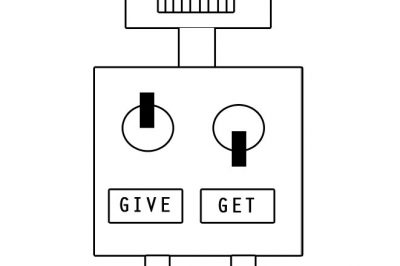
Meet Binky. She’s a good robot, as far as robots go. She’s a little immodest, but we won’t hold that against her.
Binky serves two purposes. She gives and she gets. When she gives, it is good. What she tries to get, her inventor believes is good, too.
Her only real downfall is that she cannot give and get at the same time. It’s troublesome to Binky and those around her, but her inventor couldn’t figure out any other way.
And unbeknownst to him, she feels things. Rudimentary things.
Like love and want. And sometimes deep melancholy over the state of robot working conditions.
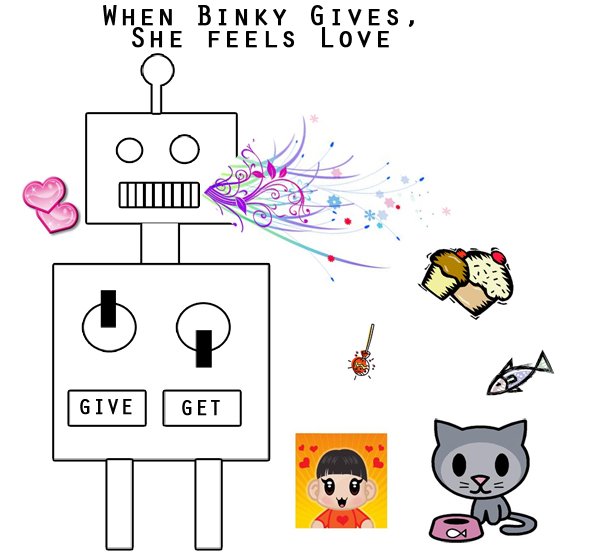
When her “give” button is switched on, she feels love. Connected.
When she’s switched on to give, she pours things out like fishes for kittens, lollipops for kids, and Microsoft Office clipart for me.
This makes her feel very, very good. She feels connected with those she’s giving to. Like she’s a part of their world; like she’s invested in their happiness.
But her inventor is afraid she’ll burn out if she just gives and gives all the time, so sometimes he switches her questionably positioned knobs to “get.”
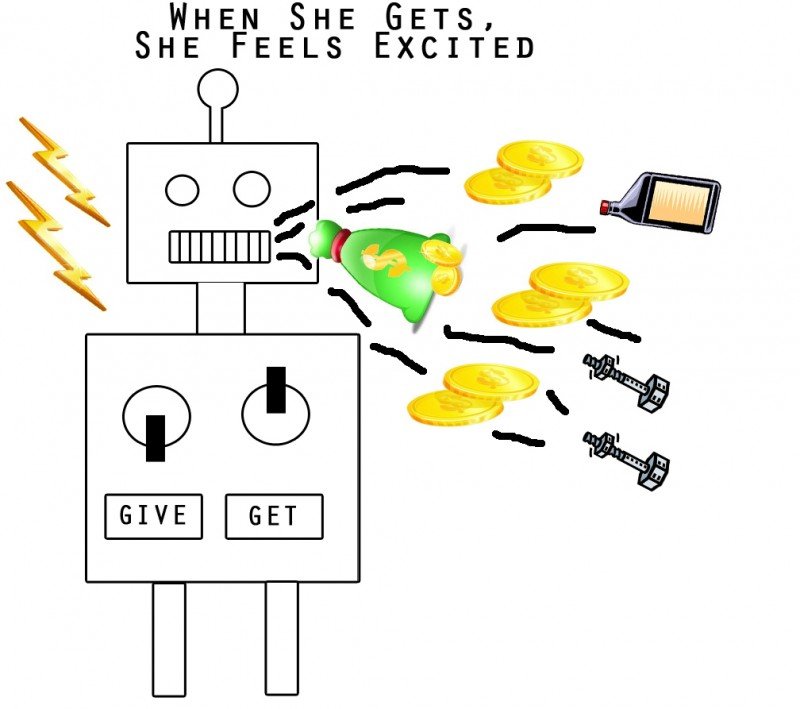
Getting is exciting for Binky. She loves the way it feels.
When she’s switched on to get, that’s all she can think about. Get get get get get. How much more can she get before her inventor switches her over again?
That’s what she wants to know.
So the longer he keeps her switched on to get, the more she doesn’t want to give. The more she doesn’t want that dadgum switch to flip. If only he’d give her a little more time. IF ONLY HE WOULD LET HER GET MORE SHINY STUFF.
And the longer she’s switched on to get, the harder she makes it for her inventor to turn those switches around.
Observing this quandary, he eventually learns that if he leaves her switched on to get only 2 hours a day, and on to give for the rest of it, he’s reached an equilibrium. But this only works if he remembers to switch her.
One day he forgot. For 24 hours. She was getting. And getting. And getting. To the point where she didn’t care who she was getting from or where she was getting it. SHE WAS GETTING AND IT WAS SO GOOD SHE WOULD NEVER STOP OH YEAH BABY THAT’S IT.
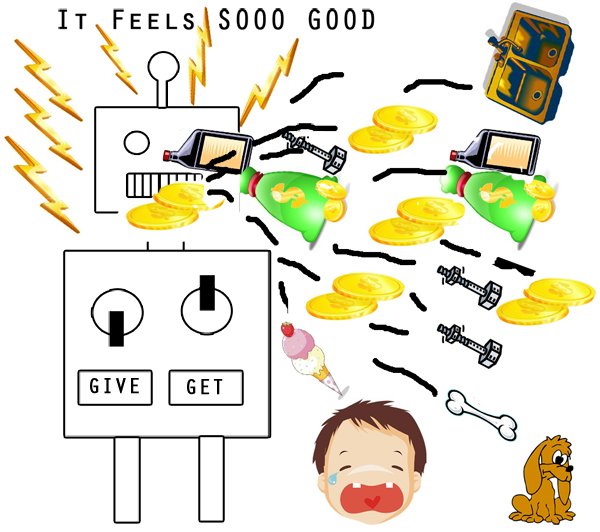
Eventually the inventor had to give up trying to switch her. She was stuck that way. Forever. And always.
The world was her oyster. And, eventually, she swallowed the world, too.
Binky Is Your Brain
Our brains do many things, and many things excite and arouse it – in wholly different ways.
The two areas we’re talking about right now are the nucleus accumbens (the pleasure center) and the posterior superior temporal sulcus (the altruism center).
From now on, we’ll just call them the pleasure center and the altruism center. It’s easier to type.
In the book Sway: The Irresistible Pull of Irrational Behavior, the authors Ori Brafman and Rom Brafman delved into studies that were done on both these areas. In these studies, participants were told to play rudimentary video games while hooked up to MRIs – the first time with the aim of gaining or losing money for themselves, and the second time with the goal of earning money for charity.
What they found was that when people are focused on the concept of earning money for themselves, the pleasure center lit up like a Christmas tree.
The pleasure center, by the way, is considered one of the “reptilian” and older portions of the brain – and it’s responsible for receiving pleasure (of course), but it’s also what’s responsible for things like drug addiction, getting excited from gambling, and desiring sex. In order for this part of the brain to continue receiving pleasure, it must have more and more of what it craves, if you continue to feed it on a regular basis.
This includes money. More specifically, the act of acquiring money or receiving monetary gain. Money seeking, therefore, can be an incredibly addictive behavior.
And wholly self serving.
When the study participants played the video game to donate to charity, an entirely different portion of the brain lit up. You guessed it, I’m sure. The altruism center.
This is the area where we process the feelings of things like compassion, connectedness, unity, forming bonds, and social interactions. The area where the concept of “oneness” takes place.
It takes much less “feeding” to get this area to light up. A little giving and compassion goes a long way, in your brain’s world.
Now, here’s the kicker: These two areas of the brain cannot – under any circumstances – be active at the same time. There is no way you can simultaneously be seeking money for yourself while feeling compassion and altruism toward other people.
No way. It’s impossible.
You cannot be self serving and compassionate at the exact same time.
The Camel Made It Through, But the American Dream Did Not
If you consider that pleasure-seeking (especially via monetary gain) is addictive, and that you physically cannot be altruistic if you’re focused on self-serving pursuits, you can see a little of why the financial system is in ruins now.
The American Dream (which was spread, so graciously, throughout the world) was based one one thing: More. More money – more money for you, more money for your family. More.
If you weren’t searching for more, if you weren’t capitalizing on more, then you were not living the American Dream. You were pathetic and poor and lazy and shifty. (Sometimes this was true, but most of the time it was an incorrect perception.)
And not only did everyone buy it, but they wanted to buy it so badly they were willing to shut off all the circuits that lead to community and connectedness.
And it was a drug. Eating the world was a drug. And that drug was not only sanctioned and encouraged by the leaders, it was fed to us through our televisions daily.
If you suspend your beliefs for a moment and consider that perhaps heaven is unity, that heaven is that experience of connectedness and oneness with all creation, then perhaps when Jesus said, “It is easier for a camel to pass through an eye of a needle than for a rich man to enter heaven” he was talking about your brain on some esoteric level.
I don’t know. I’m no theologian, but that’s the very first thing I thought of when I read that portion of the book.
Needles popped up. Camels went through.
And the American Dream no longer looked like a road to utopia at all.
So What Is the Answer?
Honestly, I don’t know.
You tell me.
This is precisely, and blatantly obviously, why I struggle with allowing myself to fully pursue monetary gain.
I think it starts with consciousness, though. Being conscious of what you’re switching “on” more often.
We cannot change the world. We can only change ourselves.
And this is somewhere to start.
Use your Binky wisely.




 Distress Your Picture Tiles – And Photo Downloads For You!
I am from a Third World country where the few and mighty rich become richer. This is at the expense of the poor who are getting poorer and… plentier!
This article means a lot. Bless you, Betty!
It’s important to recognize the difference between absolute wealth and relative wealth. Up to a certain point, increases in wealth correspond with increases in mostly universal human necessities for feeling happy and secure and being healthy – absolute wealth. After that point additional wealth measure comparatively – relative wealth.
The “rat race” is the result of relative gains in wealth. Humans rather innately compare themselves to people in their peer groups. Look at what happens:
Imagine a peer group of 2 people, Sally and Sam, who both exceed their absolute wealth needs.
Sally gets a raise of 5 dollars. Compared to Sam, she gained 5 dollars. Sam compares himself to Sally and relatively has 5 less dollars.
Sam then gets a raise of 5 dollars. Compared to Sally, he gained 5 dollars. And so on.
This is called a zero-sum game: For “x” gain there is “x” loss. The problem with this game is…..people end up working more! What ends up happening is both Sally and Sam work more….for a net neutral affect. People are capable of escaping this vicious spiral through understanding and honest reflection. Don’t be Sally or Sam!
I have worked with people for so long and have found this is one of the most common functions within someone that is out of balance. MANY givers are terrible receivers. Many people only focused on getting, don’t value the receiving.
I AM A GIVER who has to work on being comfortable to receive, like many things it is all about balance. For every action there is a counter action. Giving/Getting,both actions when out of balance can be harmful or abused. But it is tha nature of things that there can not be one without the other. In the end I strongly feel that gratitude and value is the key. After all “Ask and you shall receive” is God’s words to us,in balance with “Do onto others as you would have them do onto you.”
That was very, very well put. And, I’ll have you know, I just read your comment without looking to see who it was and thought, “What a well-balanced, insightful commenter. I can’t wait to tell them how I think they’re wise.” And then it was you! So thank you. You are wise.
Ultimately, my entire thought process while thinking this through, writing it, and reading what other people had to say was: It is important to give, and it is also important to “get,” but you should be conscious of the time you spend doing either of those things. Especially the getting part. And if you can get and be grateful at the same time, then you’ve achieved even better balance than before.
What can I say thoughtful, inspired minds often think alike! After all, it is your mission now to find your power and your balance while standing for your beliefs. Something I searched long and hard for in my line of work 🙂
In doing so, you turn over many stones, climb many mountains, walk many miles, speak many, many, many words, in search of the resonating truth within your being. This process is reflected in beauty in your life, your body and your mind.
Love of money vs. cheerful giver. The fact that we can be aware of our inherent nature and tendencies means we can try to make better choices. It’s not easy, but then nothing worthwhile is. What’s easy is keeping the blinders on and not seeing the cause and effect of our choices. Money isn’t evil. Having it isn’t either. It’s a necessity. What we do with it and how we feel about it are the key factors. (thought-provoking post!)
Perhaps heaven is unity.
That is so beautiful and so powerful.
There is an answer that many don’t want to hear. The problem is sin and our sin nature. The answer it turning your life over to the one Who is control of everything, except your will. God is the answer to every problem. We make choices every day, even making no choice is s choice. What we choose determines what we will do and think. I choose the Lord, Jesus Christ.
I’ll piggy back on to this. Jesus also said : seek first the kingdom of God and all these things shall be added unto you.
In essence – when you put God first in everything, He provides what you need. Your perspective changes, and money becomes only a means to an end instead of a pleasure thing.
a good book on this subject is Desiring God. It’s all about how following God is in one sense hedonistic…but John Piper, the author, redefines the term. I would suggest it if you actually want to figure out a good balance. :- D
Some people are naturally gifted to make money, they don’t find opportunity, opportunity lays down at their feet. I know a man who just knows how to take advantage of opportunities that fall into his lap. He and his wife are quite well off, but they do not hoard it all for themselves, and they have ethical business practices. I think they pretty much don’t give a hoot about money, except he’s just a magnet for wealth. This couple do a lot of good with the money they make. He has single-handedly funded churches being built. He gives to all kinds of charity and does way more than “tithe” (give 10% of earnings to the church).
If you have a “giving” mindset and you “get” something, then you have that much more to give.
But if you have a “getting” mindset, anything you get somehow never actually makes it back out into giving.
If we start getting, I won’t look the gift horse in the mouth, so to speak, but I WILL remember that it is a gift, and that it is meant to be shared.
Sometimes, human beings just need to own up to their selfishness and try going without something we want, so that someone else can get what they need, for a change. Thanks for flicking the switch, Betty. 🙂
This is a fascinating article on a subject I’ve done much reflection on. Being raised by *very* politically active parents in the ’70s, I grew up with the strong belief that the wealthy & powerful were ‘bad’ people and the poor ‘good.’ (Except for a few philanthropic and likeminded celebrities who supported The Cause du jour.)
But here’s the funny thing about money: on its own it has no value. Literally. Our currency isn’t even backed by precious metals anymore. Money has no value, can do no harm or good, until we assign a value to it.
It’s why our pleasure center is activated by the thought of money. Not because money itself is pleasurable, but because of the value we assign to it. For most of us, that value equals food, shelter, safety and sex. The basic needs for human survival.
Money’s abstract nature gives it a mystique that many of us can feel intimidated by. As if money has the power to change who we are. It does not.
Just as money can have an addictive quality, like sex, food, drugs and alcohol, if I truly know my Self…and am comfortable with what I find in Her…money can’t do anything to me but pay my bills and buy me that Cuban dinner I love so much. Oh…and a pedicure every now and then never ruined me either 🙂
Thanks again!! Great food for thought.
You know where I stand on the matter of making money.
I also think it’s totally possible to be compassionate and giving while earning money. There is absolutely nothing wrong with earning a living – even if it’s a way above average living. Not everyone who is in ‘get’ mode goes over the top crazy. Not everyone is going to con your grandma out of her life savings to get more for themselves. Not everyone is going to kick compassion to the curb just because they want to earn money.
I really do believe that it’s okay and possible to provide a service to people and get that warm fuzzy feel-good feeling while looking for ways to make money. Maybe a lot of people don’t make it there, but that sweet spot is where we should be aiming for.
Binky is an awesome way to illustrate your point! I posted about having enough earlier this week, and I suspect that there are more than two give/get settings. I’m getting to a point in my life where I feel like I’m happy with what I have and how I live. It’s not really a balance between giving and getting so much as contentment and recognizing when I no longer need more.
I completely agree that the drive to attain more (and more) has been terrible for any sense of social and environmental responsibility. And consciousness is definitely part of the equation. Great post.
I agree with Vanessa- and isn’t trading giving and getting at the same time as well?
Hell, forget who the money’s for, I’d be happy just playing the video game. Maybe I feel that way, though, because I work a non paying job that benefits uninsured, low income patients every day.
But it’s odd that you say that you can’t be self-serving and compassionate at the same time, because I feel both all the time. I love my job, I love helping people (compassion) – it makes me happy (self-serving pleasure). Maybe I’m the odd one out.
Giving feels good and we do it more because we love it. It’s a paradox you only understand by giving. Getters don’t get it.
Fantastic idea and very well laid out! I think the concept of switching on to give is something we need to train ourselves to do. I may be alone in this, but I don’t think giving is Binky’s natural state. You definitely gave me something to think about this morning!
Good food for thought. It kinda caught me off guard this morning but I’m pretty sure it’s going to be on my mind all day. Something we should all think about more. Thanks for sharing.
I reckon if we all knew ‘the answer’, we may as well pack up and go home. Finding the answer is what keeps life interesting 😀
Happy searching!