
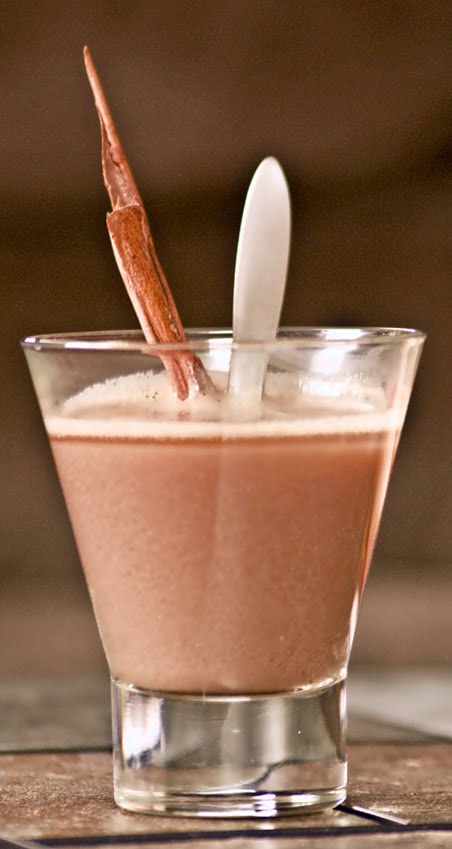
A year ago, I learned how to make chai. I made it for myself, patrons at my friend’s creperie, my friends and family – pretty much anyone who didn’t turn around and run away from my cinnamon-stick wielding passion.
I was obsessed. That also happened to be the time when I was thinking of starting this blog. I posted this (the only thing) to a Blogger account and then promptly forgot about it.
It’s epic. By the end of it, you’ll know everything you need to know about making your own chai – including how friggin’ healthy it is. It’s shameful, something this delicious being this healthy. Anyway, without further ado, I give you …
The Chai Life: Make Your Own Chai … and Love It
I’ve been making chai all of six weeks now. I’ve been drinking it – sometimes passionately, sometimes with great disdain – for years. If you’ve ever gone to Starbucks and thought “I could do this SO much better,” keep a reading. Good things are in store for you.
In all of my chai drinking years, I’ve rarely ran across a blend that satisfied my need for deep, hearty spiciness. After my last unsatisfying order at Borders, I decided to take matters into my own hands. Surprisingly, chai is very easy to make from scratch. It can also be as expensive (or inexpensive) as you want to make it. But, more than anything, it’s incredibly rewarding to do from start to finish.
The word “chai” in Hindi means “tea.” How easy is that? In India, the drink we associate with the single word “chai” is actually referred to as Masala chai – a good factoid to throw out when you’re bragging about your awesome creation. Interestingly, the word “chai” in Hebrew is synonymous with “alive” or “to live.”
Not to get too corny, but I can think of no better way to describe the all-sensory feeling you get when you’re brewing the tea.
With its magical taste, the visually stimulating beauty of the spices, the tactile surprises in cutting and crushing the ingredients, the comforting sound of gently boiling water, and the exhilarating aroma that literally fills your head, making your own chai is almost a religious experience. It’s a fast-track to practicing mindful eating (or drinking, as the case may be).
Perhaps the best thing about our western chai is that we have no cultural ties that keep us clinging to purist methods. Like chocolate in your chai? YAY! Go for it! While you’re at it, throw some dried cherries in the brew, as well. And, if you’re feeling saucy, finish your creamy creation with a healthy shot of vodka. We dontt judge. You conceptualize it, you create it, you nurture it, and then you drink it. Kind of like a baby, except for the drinking it part. (I hope.)
And the health benefits! Good grief. It’s so rare that something so delicious is crazy healthy for you, but chai is exploding with spices that will knock your nutritional socks off (not to mention, if you use black tea, the nice caffeine zing you’ll get).
Before I get to the nitty gritty and tell you my chai-making secrets, let’s just look at some of the purported health benefits of the main ingredients in Masala chai:
Look at these Health Benefits of Chai Tea … Just Look At Them
Ginger: Grrrrreat for digestion (and calming an unhappy tummy), super anti-inflammatory effects, immunity-boosting compounds, potential anticancer agents, potential alleviation of headaches and woman-cramps, and a DELISH source of magnesium, potassium, manganese, selenium, and vitamins C, E, and B6.
Cardamom: Used for digestive problems, mouth infections, and respiratory tract problems; an excellent source of vitamin C, thiamin, riboflavin, iron, magnesium, and manganese.
Cinnamon: Oh, the list we could make for this wonder spice! Briefly, cinnamon helps regulate blood sugar (my stalwart traditional-medicine-minded father even uses it for his diabetes), helps with colds and unpleasant breath, may reduce the risk of colon cancer, eases digestive problems … and the list goes on. It’s packed with choline, magnesium, calcium, and potassium, as well as high in vitamins A, C, and E.
Clove: Like cinnamon, clove may aid in blood sugar regulation, but it’s also great for tooth pain (my go-to for the broken tooth I keep forgetting to get fixed), coughs and colds, and digestive problems. It’s full of calcium, magnesium, vitamins A and C, and potassium.
Now that we know just a smidge of the health benefits of chai, let’s go ahead and get to the reason we’re all here.
Advice.
I will give it, you will take it, and I promise you will love your new brew with passion and fervor (and perhaps a little unease in believing that your mere mortal hands could make something so supernaturally delicious).
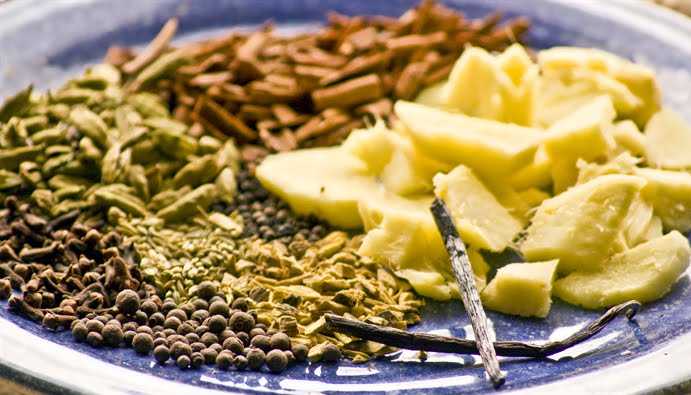
The Monster List of Optional Chai Ingredients
- Ginger*
- Cardamom pods (roasted and crushed/cracked)*
- Cinnamon sticks*
- Whole cloves*
- Black (or white, if you’re lucky enough to find some) peppercorns*
- Fennel*
- Black tea, loose (preferably Assam or Darjeeling, but any will do in a pinch)*
- White (or black if you’re unable to find white) poppy seeds
- Allspice berries (crushed/cracked)
- Star anise
- Licorice root
- Bay leaves
- Chocolate (cocoa powder or the most pure dark chocolate you can find (I’ll discuss why later)
- Vanilla beans
- Lemon zest
- Marshmallow root (which, after my own wacky experimentation, I insist on making my chai with every time (seems to mellow the brew and bridge the spicy heat and the sweet)
- Lemongrass
- Cumin
- Coriander
- Saffron
- Dried cherries
- Nutmeg
- Whatever else your spice cabinet calls you to use
- Honey, evaporated cane juice or molasses to sweeten (try to stay away from granulated sugar, babies; it’s bad for you, and it doesn’t taste as rich)*
- Milk, heavy cream, soy milk, or rice milk (as the “creamy” half)*
Chai-Making Rules
There are none.
Just kidding. There are almost none.
- This is YOUR creation. Make it yours. I will give you suggestions, but my experience in chai-making has been one of complete folly and fun. If you follow your mood and your intuition, you will – without a doubt – end up with something marvelous. Don’t be afraid! It’s only tea.
- Thou mustn’t boil the fennel and black tea. These things (in my experience) become somewhat bitter when boiled. Save these for last.
- For spicier tea, brew longer. A no-brainer, but still.
- Try to use whole spices (i.e. whole cloves, allspice berries, cardamom pods) instead of powder. It makes for easier straining, and (in my opinion) a livelier infusion.
- Love every second of it – from the preparation of ingredients, to the deliriously heady scent, to the magical moment it all touches your tongue. Don’t just make the chai – be the chai.
- Make more than you need for one serving. Store the rest in a glass container in your refrigerator for up to a week or two. Reheat or drink cold.
- When using chocolate, remember that chocolate and water make for a goopy disaster if you’re not careful. I have found that if I use good dark chocolate, it will not coagulate and get as clumpy, but you can use cocoa powder, as well. Either way, a good strain through a wire-mesh sieve or cheesecloth will solve the problem. Chocolate should be added toward the very end of the boiling time to avoid burning.
Crunchy Betty’s Favorite Chai Recipe
Makes 8 cups of chai concentrate (or 16 mugs of concentrate mixed with the “milk” agent of your choice). This recipe is based on how I like my chai – strong and effective.
- 7 cinnamon sticks, broken into smallish pieces
- 8-10 cardamom pods (roasted and crushed/cracked)
- 10-13 whole cloves
- One healthy-sized piece of ginger root (approximately the length of a key or 2 to 2-1/2 inches), cut into small nickel-sized pieces
- 3/4 to 1 tsp black peppercorns
- 2 vanilla beans (slice down the middle and scrape the beans into the pot before adding the outer casing) **(this ingredient is not necessary, and sometimes hard to find inexpensively, but I love it to pieces)
- 9 cups of cold water
- 1-1/2 Tablespoons fennel seed (or anise seed) (do not add until you’ve taken the pot off the heat)
- 3 Tablespoons black tea
- Honey or evaporated cane juice
- Milk product (milk, cream, soy milk, rice milk, or almond milk)
Now, this is the fun part. Go back to the “Potentially Amazing Chai” list above, and pick anything else that sounds appropriate and delicious to you. Add one thing, add five things of whatever you’re in the mood for. Or just stick with the above. That’s fine, too. Either way, start basic and then get crazy creative.
Throw all of the above into a large pot and add the water. Place your pot on the stove and crank up the heat until you get a nice, calm boil going. Pop on a lid and let it do its thing for 30 minutes (shorter for weaker tea, longer for stronger). Taste the chai a few times while you’re brewing – just remember that you’ll be adding the dark tea and fennel in a bit. But get a feel for what this particular batch of chai really needs. Feel free to add whatever you’d like as it strikes you. And feel free, when you lift off the lid, to sink to the floor in ecstasy when the delicious smell hits your nose.
After your boiling time has come to an end, take the pot off the burner and add the fennel seeds and black tea. Let this steep for 5 minutes (again, say it with me “shorter for weaker tea, longer for stronger”).
You should have a nice heavy mix of spices and tea going on by this point, so get your muscles prepared for the only hard part. Strain your mix over a wire-mesh sieve or cheese cloth and into an appropriately-sized container. Sometimes I will strain twice (wire mesh first, cheesecloth second) if my mixture seems to have more remnants than it should.
After you’ve cleared out all of the ingredients and are left with just the liquid, add your sweetener to taste. For a pot this size, I will use a quarter cup of honey and a half cup of evaporated cane juice, but I like my chai as sweet as I like it spicy. Dissolve this well.
Now fill your glass half full (or to the height of however chai-ey you want it) with the concentrate and fill the rest with your desired milk product.
Stir. Inhale. Drink.
Save the rest in the fridge for later. I promise, you’ll want more.
And don’t blame me if Starbucks starts losing business!

 Bathroom Cleaning (psst – I mean Make Your Own Love Balm)
How can I not be interested after reading this! I`m on my way to the store…
Can’t wait to try this! I’ve just tasted chai tea for the first time. I know. You’re like “Where have YOU been?” Was just wondering how long this concentrate would stay fresh in the fridge?
Wow this is SO good. The smell alone is spectacular. I made this my own by mixing the chilled concentrate with unsweetened coconut water for a healthy, spicy, fragrant and different summer iced tea. Yowza – it’s super good and crazy healthy too!
I forgot to mention that there are two kinds of cardamom that I know of… green cardamom, and black cardamom. I recommend people get the green variety for their tea
I love the idea of making my own! I don’t like “normal teas”, so I can leave out the black tea! It’s on the stove right now as we speak… I went to check on it and when I got a whiff, I had a sudden urge to toss in some apple slices, but I’m not so sure how long that would keep. I think perhaps for my first attempt I’ll abstain from the apples, but next time I’ll try it for sure! I was introduced to chai tea by a friend, and she taught me to make the tea and then to use the tea to make my hot chocolate as I would normally do. Soooooo delicious!
This looks delicous! I love chai tea, and although I love to make things, I have never concidered to make my own! I am making mine right now, it is boiling away. Just in time for a good Christmas drink to share for the family. Thanks for posting this!
I ALWAYS boil my fennel! LOL! But not for long.
You don’t mention what kind of tea to use. I tried for years to make masala chai using the best Assam and Darjeeling teas, and every attempt was a miserable failure. It takes a STRONG tea to stand up to the spices and milk in masala chai.
You want the mamri-style (CTC, cut-tear-curl, basically this is how they process the tea leaves). In India this is common knowledge, but here in the USA, people equate loose tea to the “good stuff”, expensive teas that, while they brew an excellent cup of tea, do not have the body or strength of character to make it as the base for masala chai. “Mamri” style tea is what goes into tea bags. If you can’t find mamri style tea (commonly available at any Indian grocery, some common brands are Brooke Bond Red Label, Taj Mahal, and Tea India), you can use cheap unflavored tea bags instead.
My version of masala chai is pretty simple. I make my masala chai in 4 easy steps, using whole spices – fennel seed, cloves, and cardamom.
1) boil water and spices for 3 mins
2) add milk and return to a rolling boil
3) add tea and simmer on low for no more than 3 mins
4) strain, serve, add sugar to taste
The full recipe is on my blog.
http://barbariansatthekitchengate.blogspot.com/2009/05/masala-chai-indian-railroad-tea.html
I love your recipe! Next time, I’ll have to try using marshmallow root, as I like my chai pretty spicy myself. I’ve posted my own recipe for chai online here: http://www.growandmake.com/make-chai-tea. Feel free to check it out!
I love your blog, love your wit, and love chai! I can’t wait to try your recipe! Many thanks for posting it!
Mwah! I love that you love my wit (especially) and everything else.
Let me know if you find a chai mix/recipe that you really, really love. I have a thing for ginger, so I go really heavy on it … but it may be time to branch out again. I’ve been making the same brew for a year now. Funny how habits work like that.
Come back soon!
LOVE this! First of all, I have loved chai for a very long time. Before my life with kids, I had a weekly ritual with a dear friend of enjoying a cup of chai at our local Indian restaurant. Yet, I have never made it myself and I am soooo excited to try this. Plus, it is a lovely post. Thanks so much! THis is a keeper!
I’ve always adored the chai latte from Starbucks until I realized it ws full of icky sugar! Then I bought Tazo chai….I adore the smell and taste of it and have recently come to love stevia in my teas too! Chai is warm and comforting…..I think your recipe is awesome as well as your blog post…so well written, entertaining, witty….forgive me for drooling….keep up the great work!
Sounds so yummy!! Even though it’s supposedly 103 out today, which is strange for this area and time of year, I’m literally a popsicle sitting here in my office (cube). I haven’t made chai in so long…no excuses or reasons why, but this post is now my motivation to brew me up some! WOOHOO thanks for sharing all your favorites.
Hiya Ms. Crunch! First I need to say i didn’t read this post, well except for the very first part, I have to go back and do that after I leave this message.
Maybe your Kitty should be named Chai… thats what I thought when I opened this and read those first few lines and made me drop everything to get it out asap!
Also I just love your writing style, I sit here day after day reading your posts and they just crack me up. “don’t use soap on your face”
You remind me of a fabulous friend I used to have. So anyhow, thanks for being you, keep posting so I can have something to look forward to brightening my day!
Ha! My other kitty should REALLY be named chai. He’s a siamese/ragdoll mix and he’s very brown. I’ll have to have a talk with Fiance about that when he gets out of the shower.
And some day, I’m going to have to meet that fabulous former friend and learn a new trick or two. Heh.
Thanks so much for the comment, and for being here, and for … you know … everything! Mwah!
This sounds amazing! I’ve long wanted to make my own masala chai. Don’t forget about all the antioxidants found in black tea… though I’d drink it just for the taste and caffeine content, it delivers on the health front too!
You’ll have to forgive if I wait until cooler weather to make this (94 in the shade yesterday). Just by reading it though, I know it will be fabulous and I can’t wait to make some.
I love chai! I just ran out of my favorite Red Rooibos chai and decided to make my own this time a round. Thanks for posting!
SOMETHING in Chai tea makes me ravenously hungry.
It’s probably not real hunger, it’s probably creating a digestive reaction that feels the same as hunger, but…I’ve avoided chai tea for years because I totally don’t need anything that makes me feel hungrier than I typically already feel.
And ideas?
I wonder if it doesn’t rev your metabolism. Maybe it’s not such a bad thing, after all.
This is kind of off-topic, but my friend and I have been having a lot of conversations about eating lately, and how the more (healthy, of course) we eat, the easier it is to lose weight. Except I’ve totally wrecked my metabolism with years of anorexia and bulimia. But I can still tell the difference in my body when I eat more (healthy) and WAY less. And eating more is better.
My point: Maybe you’re supposed to eat more anyway?
That is all.
Hey Betty, I am SO glad to see this chai recipe! (By the way, I am a new subscriber, so, hi!) I am also a bit of a chai snob (having it freshly made one time ruined the boxed stuff for me forever – which is the only thing available from coffee shops/stores where I live) and I have been thinking lately that I need to search for a recipe to make it fresh, but you did it for me! Thanks so much!
As a follow-up to Lori’s comment, I wanted to share something a friend told me recently, this friend being a food microbiologist. In layman’s terms, she told me that coffee has a particular chemical in it that inhibits the body’s ability to tell if the stomach is full (which in my own experience explains a lot in relation to drinking coffee and consuming food). I’m not sure if this chemical would be caffeine or just a chemical common to both coffee and black tea? In any case, maybe subbing out black tea for something else might help, if that’s possible… I’m no tea afficionado so unfortunately I don’t have any suggestions. 🙂
Very interesting…
I don’t have the same sensation when I drink coffee, but I DO have the same sensation when I drink some other teas. Tannins? No, wait, that’s wine.
I DO have the same sensation when I eat high cellulose foods – apples, oranges, celery.
I think I’m broken.
*sigh*
I find the same thing, but I’ve always reasoned that it’s because I’ve been drinking coffee regularly (like 3 cups a day) for years, but I rarely have tea. So these funny hungry cravings that I get with coffee are just worked into my regular schedule or my body has learned to adapt.
And then there are the years that I’m drinking only tea with the occasional cup of coffee. The exact opposite happens! I’m not hungry / craving food after drinking tea, but a cup of coffee and I’m ravenous.
And I have the same feeling with high cellulose foods also.
I try to pair them with a small protein ALWAYS. So an apple will be accompanied by a few almonds, celery with peanut butter. Chai will be accompanied with some roasted peanuts or one of my tiny almond-flour muffins. It helps a bunch!!
Good luck figuring this all out1
I fell in love with chai after my neighbors from India started inviting me over for tea every afternoon. She made it from scratch with garlic included and I’ve never had such a good cup of chai. I can’t wait to try this, I’ve been using store bought masala spices from the Indian grocery store ever since they moved to Texas and it just hasn’t been the same, so I have a feeling this will be quite a treat!! : )
I love chai! Drinking cup of chai is so relaxing and warming during cold season.
Ohhhhhhhh my goodness. Thisissowonderful. SO wonderful! My favourite part of autumn is the return of my yen for chai.