
It seems like every couple of years, there’s a new miracle fruit, antioxidant, oil, vegetable, nut, or cat.
(Not really the cat thing, except mine.)
Tamanu might have actually already had its heyday, but up until about 6 months ago, I’d never heard of it.
Most famously, I’ve read of many people who use it to help with their acne. And, pretty much across the board, the consensus is that it works.
Confession: Sometimes I get pimples on my cheeks still. And I pick them, unconsciously. And they turn into scabs. It’s a horrible, horrible habit STOP JUDGING ME.
I’ve mostly used tamanu when I do those terrible, horrible, no good, very bad things. I can honestly say that the healing time seems drastically reduced. Where, maybe, it would’ve taken a week for one to heal, it’s usually gone in three or four days.
BUT (tada!) that’s not all it’s useful for. Among other things, it’s been scientifically shown to reduce the appearance of stretch marks (and I get TONS of emails asking about how to do that), it heals burns and wounds, soothes and heals insect bites, scabies, athlete’s foot, chapped lips … the list really does go on and on and on.
What On EARTH is Tamanu Oil?
Tell me if I’m wrong: Tamanu kinda sounds like an animal, right? When I first read the word, I envisioned a lopsided sheep-goat animal that rolls around in the mud and bleats like a stretched-thin balloon stem.
It is not.
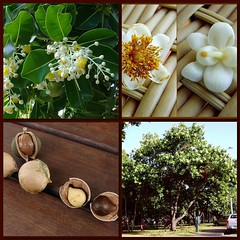
It’s actually a beautiful flowering tree that blooms twice a year and produces fruit that taste similar to apples. In the middle of these fruits are seeds. Within the seed is the oil.
Extracting this oil sounds to be an arduous practice, as they have to climate-control the rooms in which they dry the seeds – and then wait patiently for them to secrete their incredible oily goodness.
The word “tamanu” originates from Tahiti, but they’re called anything from “kamani” in Hawaii, to “dilo” in Fiji, to “Ballnut” in Australia.
Oh, you Aussies.
Tamanu oil is incredibly rich in fatty acids, and it’s also full of compounds that science hasn’t completely isolated yet. One thing that is known for sure is that it’s highly antibacterial, antimicrobial, antifungal, and antioxidant.
All over the world (but especially in the Southern portions), its sap, oil, and leaves are used to treat:
- Psoriasis
- Diabetic ulcers
- Acne
- Scarring
- Athlete’s foot
- Scabies
- Scrapes and cuts
- Sunburns
- Diaper rash
- Sore throats (applied topically, even)
- Joint aches and pains
And, seriously. The list still goes on from there.
But here’s my new favorite thing to do with it.
Exfoliating, Healing Tamanu Oil Dry Scrub
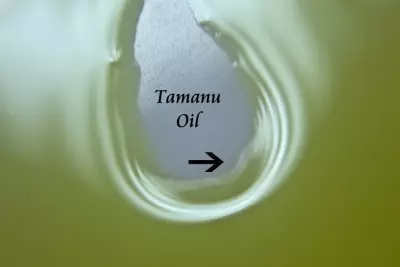
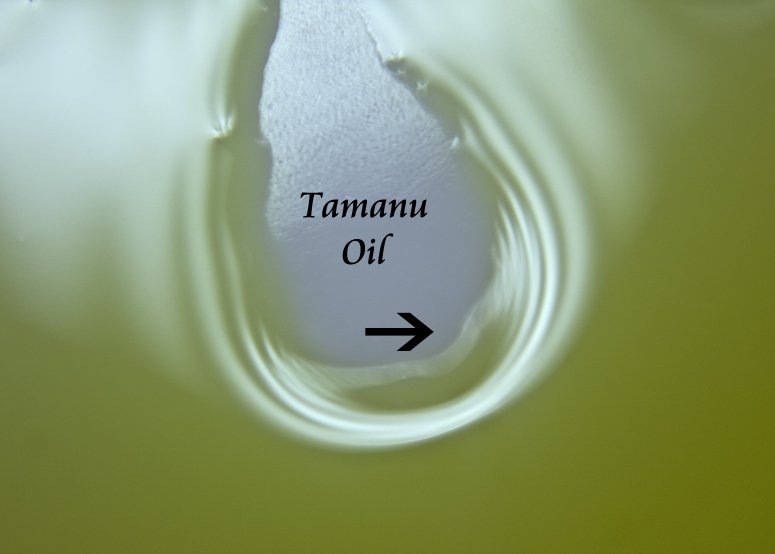
Tamanu oil is really thick and slightly fragrant (like … green fruit), and it takes a while to sink all the way in. This makes it not the most attractive option – alone – as a facial moisturizer, at least if you’re planning on doing anything in public for about 2 hours after applying it.
However, I do add it to my “kitchen-sink” facial oil mix that I use nightly. Once it’s thinned out a bit, it goes on like a charm.
My favorite way to use it happens to be as more of a dry scrub.
You can use this scrub on your face (although not recommended for OPEN wounds … I use it once the healing process has started and there’s no true broken skin left), on your stretch marks, or anywhere you want to exfoliate, encourage the tamanu to sink into your skin, and ultimately soften and heal.
How to Do the Tamanu Oil Dry Scrub:
- Rub a thick-ish layer of tamanu oil over the skin you want to exfoliate. (Make sure your skin is clean, i.e. NO makeup.)
- Massage for a minute or two.
- Take a small handful of sugar into the palm of your hand, and very, very softly massage the sugar around on your skin.
- Do this for 3-5 minutes.
- Rinse the sugar off with water.
Left behind will be amazingly soft, glowing skin. It may still feel a tiny bit oily for a while, but it sinks in relatively quickly. Within 10-15 minutes.
Technically, you can use this method with any oil you’d like – especially olive.
I do feel like, though, since doing this weekly (for about three weeks), I’ve had far fewer issues with dry patches on the tops of my cheekbones and pimples on my cheeks.
Have You Used Tamanu Oil Before?
Are you way ahead of the curve and have known all about tamanu this whole time?
I’d love to hear your personal experience with it.
It’s one of my new favorite oils; one I really don’t know if I’ll want to go without in the future.
Plus, it sounds like such a great medicine cabinet addition for burns and scrapes.
Almost makes me want to go skateboarding – just to test it out.
(Someone talk me out of this before I get hurt.)

 Are You Prepared For a Water EMERGENCY!?!?
An intriguing discussion is worth comment. I do believe that you need
to write more on this subject matter, it might not be a taboo subject but typically folks don’t speak about these subjects.
To the next! Cheers!!
That is a very good tip particularly to those fresh to
the blogosphere. Short but very precise info… Thanks for sharing this one.
A must read article!
Iam visiting Fiji and my son gave me some to try. I tried it on my mosquito bites took the itch away immediately. Just tried the scrub it was amazing. I am sold on Tamanu oil.
Thanks for the good writeup. It in fact was
once a enjoyment account it. Glance complex to far brought agreeable from you!
However, how can we keep up a correspondence?
Hey, I think your website might be having browser compatibility issues.
When I look at your blog site in Safari, it looks fine but when opening in Internet Explorer, it has
some overlapping. I just wanted to give you a quick heads up!
Other then that, awesome blog!
If some one wants to be updated with hottest technologies afterward he must be go to see this web site and be up to date every day.
Seɦr schöner Pⲟst! Ich gucke mir sehr gerne Vidᥱos Online an. Vorallem ⅼiebᥱ ich Νetfⅼіҳ.
My partner and I stumbled over here from a different web page and thought I might as
well check things out. I like what I see so now i’m following you.
Look forward to exploring your web page again.
Appreciation to my father who told me concerning this blog, this web site is
genuinely awesome.
What i do not realize is if truth be told how you’re now not really a lot more well-favored than you
may be now. You are so intelligent. You know therefore considerably in the case of this topic, produced me
in my opinion believe it from so many varied angles.
Its like men and women don’t seem to be involved except it is one thing to accomplish
with Woman gaga! Your own stuffs excellent. All
the time care for it up!
Howdy! I could have sworn I’ve been to this website before but after looking at many of the posts I realized it’s new
to me. Anyways, I’m certainly happy I found it and I’ll be bookmarking it
and checking back regularly!
Callgirl, Begleitdame Geschlechtsverkehr
Hello it’s me, I am also visiting this web site regularly,
this website is truly nice and the users are truly sharing pleasant thoughts.
Thanks to my father who informed me on the topic of this weblog, this website
is in fact amazing.
hi ! am interested in your Tamanu oil…
I’ve been searching for cure… am prone to mosquito bites and it leaves well… scars every time the redness subsides..
Can this help diminish the scars?…
I cant wear skirt or shorts cause the damage is too obvious…
Hoping for your response…
It will be greatly appreciated…
I’d like to thank you for the efforts you have put in penning
this website. I am hoping to check out the same high-grade content from
you later on as well. In fact, your creative writing abilities has encouraged me to get my own, personal
site now 😉
It’s remarkable designed for me to have a web site, which is good for my knowledge.
thanks admin
Hi to every one, because I am in fact keen of reading this
blog’s post to be updated regularly. It consists of good
material.
This site was… how do I say it? Relevant!! Finally
I’ve found something which helped me. Kudos!
When someone writes an piece of writing he/she keeps the thought of a
user in his/her brain that how a user can be aware of it.
Therefore that’s why this article is perfect.
Thanks!
You really make it seem really easy together with your presentation however I to find this matter
to be really something which I think I would by no means understand.
It seems too complex and extremely broad for me.
I’m taking a look forward in your next publish, I’ll attempt to get the
grasp of it!
Choisissez un voyage au Cambodge Son passe historique et culturel se reflete dans
le website d’Angkor.
Thanks , I’ve recently been searching for information about
this subject for ages and yours is the best I have discovered till
now. But, what concerning the conclusion? Are
you sure concerning the source?
To apply for short term payday loans all you have to do first is
to fill the web application form and provide details like your contact address,
phone variety, form of loan you would like
to avail etc. Everything can be done in the comfort of his home or office.
Individuals can also have an opportunity to utilize these deals irrespective of his poor fiscal standing.
Yes! Finally something about can ho dat gia.
Wonderful article! We will be linking to this great post on our website.
Keep up the good writing.
The Samajwadi Party manifesto further says a big no to the
FDI in retail market in Uttar Pradesh. **Exact Steps** This Former Retail Worker Made, To End Up
Working FULL Time From Home. For example, news
about business, sports and politics are individually telecasted and then all news is put
together and is then transmitted in various slos.
Coach 1.four.8 (steam) No Damage, Limitless Money, Add EXP/EP, Edit Money, Set All Abilities to Max.
However, what that Russian site did in the winter is now being matched
by a Polish site this summer.
I am truly glad to read this weblog posts which contains plenty
of valuable data, thanks for providing these kinds of information.
A fascinating discussion is definitely worth comment.
I think that you need to write more on this subject, it might not be
a taboo subject but usually people do not talk about these
topics. To the next! Best wishes!!
Hi my family member! I wish to say that this article
is awesome, great written and include almost all important infos.
I would like to peer more posts like this .
Hello my loved one! I wish to say that this article is amazing, nice writtn and come with
almkost all vital infos. I’d like to see more posts like this .
It is truly a nice and useful piece of information. I’m satisfied that you shared this helpful information with us.
Please stay us up to date like this. Thanks for
sharing.
In fact when someone doesn’t understand afterward its
up to other viewers that they will assist, so here it occurs.
I think the admin of this web page is truly working hard in support of his website, because here
every information is quality based data.
Everyone loves what you guys are usually up too.
This kind of clever work and reporting! Keep up the terrific works
guys I’ve included you guys to blogroll.
If some one desires to be updated with newest technologies after that he must be
pay a visit this site and be up to date all the time.
I just like the valuable information you provide in your articles.
I will bookmark your blog and test once more right here
frequently. I’m reasonably certain I’ll
learn many new stuff proper here! Good luck for the next!
It’s great that you are getting ideas from this paragraph as well as from our argument made
at this time.
Awesome post.
Thanks for sharing such a nice thought, paragraph is nice, thats
why i have read it completely
Grants you a royalty-free, non-exclusive, non-transferable license to use the Software, solely for
your personal, non-commercial purposes.
you’re really a good webmaster. The web site loading velocity is amazing.
It seems that you’re doing any unique trick.
Also, The contents are masterpiece. you have performed a great task on this matter!
Happy Hour is another great thing to get in on as anything can happen when it’s Happy Hour.
Here, it would be worth adding that the said group is a public listed company.
Looking at the State Senate, the 52nd, 54th, 57th, and 58th Districts are all held by Republicans.
Я крайне впечатлен ваши навыки а также с макетом на вашем блоге
. Является ли это заплатил тема
или вы изменить ее самостоятельно?
В любом случае в ногу отличную качественной записи, это редко можно увидеть
хороший блог, как этот в настоящее время .
Howdy! I could have sworn I’ve been to this site before but after looking at many of
the articles I realized it’s new to me. Regardless, I’m certainly
pleased I stumbled upon it and I’ll be book-marking it and checking back frequently!
Hello may i know where can i buy this product? I wanna try this on my stretch marks and dark scars or marks from insect bites. Please….. Im from Philippines..
Hello may i know where can i buy this product? I wanna try this on my stretch marks and dark scars or marks from insect bites. Please…..
Hi! I was looking to buy one and I came across this: https://www.mountainroseherbs.com/products/tamanu-oil/profile. Do you think this is legit? Your’s is lightish green but this one is dark green. Just kind of sketched out and wanted to make sure. Lol.
Looks promising, however, I am worried that tamanu oils are bit expensive? Was wondering if you could recommend a brand and shops where to buy these oils? Thanks. – John
I know this is an old comment but wanted to put this out there! I got my tamanu oil form mountainroseherbs.com. It’s cold pressed and organic-both things you want! For $14 I got 4oz! You only need a tiny bit- It goes so far so this will last me probably a year. Super cheap and good stuff!Hope this helps anyone looking for tamanu!
Hello there! This is my first visit to your blog!
We are a group of volunteers and starting a new initiative in a community in the
same niche. Your blog provided us beneficial information to work on.
You have done a marvellous job!
Have you or anyone experience adverse effects from the use of honey? My experience: I applied only honey to my face to wash it, the next morning when I awaken, My face was red in some areas with tiny bumps, whelps, and it burned as well as itched like crazy. It has left my face with dark areas around my mouth, chin and neck which is dry,cracked, flakey, itchy as well as burns. It looks as if my skin has been burned. I have never had problems with my skin other than a little dryness. Please help!
Just wanted to point out that no part of the Tamanu fruit or kernel should ever be ingested since it is poisonous (“produces fruit that taste similar to apples”). Source http://en.wikipedia.org/wiki/Calophyllum_inophyllum As a topical oil however it is remarkable with a myriad of uses! Thanks for spreading the word Crunchy Betty.
Where have you found to be the most economical place to buy tamanu oil?
Brambleberry.com
I got mine here: https://www.mountainroseherbs.com/products/tamanu-oil/profile
Hey all!! A few months ago, I broke out after a week of antibiotics. Recently, I’ve been on the Autoimmune Paleo diet, taking supplements/probiotics, washing my face less and using apple cider vinegar as toner. I just started using MSM cream and using Tamanu oil for spot treatments on the red marks left behind. I was just wondering if anyone had any initial breakouts from using this oil? I’ve had pretty sensitive skin in the past and my skin is just starting to get back on the clear path. I just don’t want to ruin anything by putting this oil on my already oily skin. Thanks! 🙂
I would say if you are allergic to nuts do not use this product as the oil is derived from a nut. And, the beauty of this oil is that it is non-greasy. It gets absorbed into the skin fairly quickly due to it’s ability to penetrate three layers of skin, quite unique to this oil!
Hi,
Very nice article, much informative. I have acne problems and scarring. Moreover, I have (most likely due to sun exposure) patch marks on my feet in a pattern. Hope I can get rid of these patches with Tamanu oil. Can you please tell me how to use it for acne? I mean how to apply it to acne?
Thank you.
I am a tamanu freak! I have turned everyone I know onto it and they’re all hooked as well. Been using it for almost 3 years now. I use it mostly for skin injuries and as a facial moisturizer at night but it is seriously a cure for anything skin related. It’s amazing. I use it daily on one thing or another. Also, a friend of mine was suffering from anal fissures (yes sounds grosssss but hey, more people have the problem than you would think. It’s also known as jeeps disease. This oil has been a miracle cure for him and it completely cleared up the problem.
My son has used it to cure jock itch, I used it just the other day on a horrible burn from splattered hot oil and my burn was seriously gone the next morning. Zero blisters.
Like you said, the list can go on and on and on. Love it!!!
After struggling with acne for 6 years and nothing working the doctor finally prescribed me with Roaccutane (as a very last resort) and I struggled with 18 weeks of awful side effects but it eventually cured my acne (yay!) until…3 years later when I fell pregnant with a little boy (hormones) and the acne came back worse than EVER all over my back, chest, shoulders, face and even stomach! A friend recommended I try Tamanu oil, after only a few days of using it all the acne on my face and chest (the places I used the oil) started to reduce and by 2 weeks later all of the active spots had gone so now I’m working on the scarring. Absolute miracle stuff!! Wish id known about it years ago and saved my body from the awful roaccutane drug! x
Hello Tara,
I am in the exact same boat, just got pregnant and my acne is WORSE THAN EVER. I am feeling very defeated and there’s not many options for treating acne while pregnant… How did you use the tamanu oil? Like, did you just rub it on your face or did you use it as a part of a skin regimen?
Thank you!!
Angie
Would you be willing to share your “kitchen sink” facial oil mix? I’ve been experimenting lately based on reading and what I’ve seen in other products and it’s great to get new ideas. Thanks!
Absolutely love love tamanu oil. It fades post acne hyper pigmentation, clears up acne, and moisturizes skin. Its my go to oil. I mix it with tea tree oil and apply at night. My skin is glowing and clear the next day. It smells awful but works like a charm.
Hi Jenn,
Wondering what ratio of tamanu oil and tea tree oil you use. Thanks so much!
Hi Crunchy Betty!
Wow! This was a very interesting read…I am a medical aesthetician starting my own skin care line, and I am blending the Tamanu oil with several others that are also anti-inflammatory and healing for acneic skin. I’ve been using it on my 14 yr old daughter who has tried MANY different topical systems, to no avail. So far, her face and back are looking better and I’m using it on a fresh cut on my décolleté to see if it helps with scarring. Also using it on someone in my office with severe dermatitis, so will keep you posted as to the results after more time has passed. FYI, blending it with lavender helps offset the Tamanu aroma…thanks for all the great info everyone!!!
Has anyone used tamandua oil for brown spots?
Crunchy Betty,
apart from its many skin ailment treatments, we use Tamanu Oil to treat our cattle for excema, screw worm, and normal cuts the cattle pickup during the day. We have noticed that it is very good fly repellant, heals cuts very quickly. Please bear in mind we make our own oil from our own trees. All our staff use this oil for any skin problem, and we no longer use any antibiotics.
Ahaa, its pleasant dialogue concerning this post here at this website, I have read all that,
so now me also commenting here.
The body shops tea tree moistureizer has this oil in it. With that same intended function. Addressing acne and the healing process
I found this to be a very effective deodorant, applied directly (100% strength) to the armpit. Only takes about 1 drop per armpit and last all day! No residue is left on clothes.
I also noticed that my cat really hates the smell of it, so I tried it as an insect repellent and it seems to work well! The smell, however, is not exciting… I’m going to try mixing with geranium and lemongrass essential oils to improve the scent (both are also known bug repellents) and dilute it all in water in a spray bottle.
The uses for this amazing oil are unending!! I am in love!
I am 44 and from the age of 19 to age 42, had many issues with breakouts. I was in and out of dermatologists and putting so many harmful chemicals on my face and taking so many antibiotics and getting sessions of some blue ray lights. All that would only help while I was going to a derm, but as soon as I was done with antibiotics my breakout would return. I began trying an expensive product from Bobbi brown and helped a lot but that began getting very expensive- a small bottle of Serum cost $140 and would last me about 4 weeks. So I began researching about natural ways of healing and came upon this Tamanu Oil and other essential oils. I began trying the Tamanu oil on my face and dried the one pimple I had on my cheek fast. However, not sure if the tamanu oil dried the skin on my eyelids or skin side of my mouth but now I know where not apply. haha. I wanted to test on me first before having my son try. I sure don’t want my son to go through what I went through and if I can help him take care of his skin now would be wonderful. Do you think this is safe for a 12 year and will this oil good for wrinkles? I would assume it is. I also learned Apple Cider Vinegar “the mother” prevents breakouts so I always have some in my shower.
Interesting stuff! I wound up here b/c I was thinking of purchasing 1 oz (for $65) of Dilo oil by Kate Somerville only to realize Dilo & Tamanu are the same. Apparently hers is mixed w a few other oils for added benefit and better smell… But I see you can get 2 oz at Mountain Rose Herbs for $7 ( plus shipping)
After oil cleansing with a castor, jojoba, tea tree blend I splash my face with rose water place a little dollop of tamanu oil in the palm of my hand, a little squirt of jojoba and a drop of jasmine oil. Rub my hands together and massage the blend into my damp face. It moisturizes beautifully, the rose water is a mild astringent, and the jasmine totally masks the tamanu scent (which isn’t that bad to begin with) so that I can use it durning the day. The tamanu is really helping with my breakouts and I don’t have any dry patches.
I am a licensed esthetician, and I LOVE Tamanu oil! My mom had been on rosacea medicine for years, and nothing really ever gave her relief. She tried Tamanu oil, and bingo! This was the answer! It totally cleared up her rosacea and she has used it faithfully for years. I keep it handy for any cut, scrape, irritation, burn, pimple etc. Love, love, love it!!
I found this blog researching essential oils and I found an anti-viral oil called Ravensara that stated mixing 50:50 with this Tamanu Oil healed shingles .. even could cause the virus to go into remission .. I know doctors say there is no “cure” but I believe God put things on this earth that can cure us of anything. I hope this info helps someone or many. Thanks
Ravensara oil is recommended in almost every aromatherapy text for Herpes Zoster, i.e. ‘Shingles’ – in a blend with Tamanu oil. Mix in a 50/50 ratio and apply regularly to the outbreak – terrific results are noted with this combination.
hi, i am trying to heal acne scars and a surgical scar and i have found several oils, and i cant choose one. do you think that the saying too many cooks spoil the broth in this type of scenario? i would liket o mix wheat germ, rose hips, tamanu and sea buckthorn. any thoughts?
Hey Ms Betty,
I tried using Tamanu oil, but it really burnt my skin, dried it out like crazy, leaving these nasty, crusty weeping abrasions under my eyes and along the sides of my nose and cheeks.
Have you heard of anyone else having a strong reaction to it? I picked up my bottle at GoNative- a wonderful online organic beauty store in New Zealand.
http://www.gonative.co.nz/shop/VegetableCarrier+Oils/Tamanu+oil+spray+free.html
Love what you do xx
Dear Ms Crunchy,
You are so much fun! HAD to contribute my experience with Tamanu. I use it at night because it’s an oil that has no aroma toxicity for kitties (like Helichrysum-and almost anything else)…they don’t recoil in horror with squinty eyes and it smells like a sort of yummy nutty topping for a sundae. Anyhoo, an UGLY looking scabby bump SUDDENLY appeared where my bra strap hits my shoulder joint-oddly not painful, but like a mole gone really bad. Couldn’t afford a dermatologist right away, so I put tamanu oil on it every night. In a week it was COMPLETELY GONE. AS if NEVER there at all-perfectly smooth unblemished skin. I wish I could afford to BATHE in Tamanu – and Frankincense.(It’s the new survival of the fittest.)
I really enjoy your crunchiness! Best regards!
GUY REVIEW:
I started using tamanu oil last summer on my body because it has an awesome omega profile and a slightly sweet/nutty scent. It was really great for the existing sunburn I had and I didn’t get burnt after that. I never thought to use it on my face because it was thick and I had given up on using facial oils because I couldnt find one I liked/ could afford. I never tried to make my own because I thought companies knew more about my skin then I did. Recently I’ve been seeing facial oils making a comeback (there was recently an article in Details about why men should use a facial oil!) so I figured what the heck. I googled how to make facial oil and read over the crunchy betty article (thanks by the way) and it reminded me of my unused portion of tamanu. It’s starting to get cold now so a little extra moisture couldn’t hurt. I’ve been using it every night for a week now and my skin is looking really great. I add 1 or 2 drops of lavender/teatree blend to 2 pumps of my Aura Cacia organic tamanu oil and it’s been working out so far.
It’s only $15 and you could technically use it as your carrier oil. I think frankincense and myrhh would be great in it.
-Hope that helps!
Bought some a month ago for the oil cleanse but never kept up with it. Saturday night I went on a picking spree, popping every pimple and digging into very blackhead. It looks like I fell face first into a thorn bush. STUPID! I had been using neosporin bc it really heals cuts faster. Then I noticed the tamanu oil and immediately rinsed the news neosporin and applied the tamanu oil… After reading this site and the comments, I’ll be sure to use it in lieu of my moisturizer in the AM. Fingers crossed I’m healed soon!!
Hello from South Africa Crunchy Betty,
As per usual, this article made me very, very curious. You write fantastically and I just love, love, love your journey.
Here we call it ‘Foraha’ and it is very expensive, even though it is made locally…however, as a little goes a long way, I’ll be taken a page from your book once again and try it.
Did I say THANKS for what you mean in my life?
xxx
Hi Anel,
Been reading this blog and came across your your comment. I too am from South African and have just found out about Tamanu, but cant seem to find anyone that sells it here. I see you mentioned a different name. Where did you get yours from?
I was just doing a search on Tamanu oil (I tested some on my hand and arm today when shopping for skincare but didn’t buy it as it is so thick, plus: how many times I’ve bought an oil/treatment/etc that promises to treat acne and scars…) and found your article. I’m happy to hear that you love it so well, I’ve read your blog in the past and agree with your findings on many things so I feel comfortable with your opinion. Also, just wanted to mention that ice cubes are really excellent for clearing and healing pimples. Literally more amazing than anything else ever and I can’t believe I didn’t learn about it longer ago.
I actually have this AMAZING lotion I bought from a shop that uses natural ingredients in all their products. Up until now, it’s just been my miracle lotion; I put it on at night, and in the morning, yay! Clearer skin! But after I read this post, I took a closer look at the label, and wouldn’t you know it? Infused with tamanu oil. The stuff is amazing.
Hi dear Lydia,
I have just bought my tamuna oil as well. Waiting for the shipping to arrive.
Would like to know the miracle lotion you are using? The brand please? able to purchase online?
thanks a bunch, pretty!
It’s from a place called The Body Shop. Their website is here:
http://www.thebodyshop-usa.com/
The lotion is called Tea Tree Blemish Fade Night Lotion. They actually have a whole line of awesome tea tree products, with all sorts of lovely effects
Very descriptive blog, I enjoyed that a lot. Will there be
a part 2?
Correction: argan oil and aura cacia (dang auto correct lol)
I recently started using this oil and love it. I apply rigorously to my stretch marks. Picked it up
In the “natural” section of Fred Meyers along with rose hip and Aegean oils from aura caviar. Great site! 😉
Everything is very open with a really clear clarification of the issues.
It was really informative. Your site is very helpful.
Thank you for sharing!
I started using tamanu oil for about two months for my acne,since then I don’t have any
major breakouts,but I have a question regarding its usage during pregnancy..Iam 5 months pregnant and I want to use this oil for stretch marks and acne.Can I use it during pregnancy?Please reply.Thanks!
Hello, I have also been reading all of these comments and am looking to see if others have used it for pregnancy belly- stretch mark prevention? Did you end up finding it was safe (I’ve been told it is), using it and how do you like it? Thanks!
I have been using tamanu oil for a few weeks and at first my skin seems less red and any new acne disappeared quickly, but lately I have notice my skin is clogged and I have new break outs and its red. I only use it at night because my skin is too oily for me to use this in the morning. I want to know if anyone has experienced breakouts? I don’t know if my skin is just purging and I’m scared to keep using this and be left with cystic acne.
This happened to me to, but I can’t tell if it’s the Tamanu oil or not! 🙁 I’m scared to keep using it but I’ve searched everywhere and it seems like Tamanu oil is supposedly safe for all skin types including sensitive skin?! I also tried it as just a spot treatment but I can’t tell if it’s making it worse or not…
worried
i just started tamanu oil 4 days ago. i’m thinking it’s drawing out the junk that’s already in the skin and we’ll see improvement in a few more days, i hope!? i’m 60 yrs old, have had bad blemished skin since i was 13. i keep thinking ‘when i grow up’ i’ll finally have nice skin! i tried Manuka Honey active 16+ for almost 2 years and it worked awesome, then it just stopped. i’m back to cystic blemishes along the jaw and hollows of my cheeks. (plus, the honey was costing $40 a jar- one month supply- one jar to use one my face and one jar to eat, 2 Tbs. daily) now i’m trying the tamanu oil for blemishes and age spots and and burn on my wrist from the oven. trying to be patient!
ps I use the tamanu oil on its own in the morning and mixed at night….
WHAT???? I have been using pure cold pressed tamanu as a moisturiser ALONE for 2 years and I can go out in public IMMEDIATELY after applying, also it does NOT take a while to soak into the skin! It takes like a MINUTE. You are supposed to shake it before hand. (I did two year beauty therapy course and did best in facial and essential oils part of the course) Also for those saying it may clog your pores, these types of oils CANNOT clog your pores! You can however select an oil that just doesn’t work for your skin type, ie too heavy…. The oil cleansing method for instance made my life a misery! Because you must use hot water to steam several times AND rub the oil off well with a facde cloth I was breaking out in CYSTIC ACNE TERRIBLE FOR 4 MONTHS before I decided enough is enough, now I quickly remove make up with olive oil then wash face with honey, rinse and then apply a honey face mask for 15 mins rinse, apply natural yogurt with chamomile extract in it (my face LOVES this) and then moisturise with almond oil and 2 drops of tamanu oil. Note my skin has NOT recovered from the awful breakout the oil cleansing caused! 6 weeks of leaving that method and new cysts have STOPPED appearing but the old ones WON’T go away!!! And there are lots, if you have acne but with COMBINATION skin or even dry skin DO NOT use the oil cleansing method, in fact really it is not a good method for 2 reasons, the facial skin is SO delicate you should NEVER rub it, especially if you have acne, also hot water should NEVER be used on the face because it dries the skin causing sebum levels to rise, (use luke warm water) and steaming should NEVER be done on acne prone skin as this too causes dryness which means your oils over work, This is a simple thing ANYONE who does level 2 beauty therapy is taught, I STUPIDLY gave the oil cleansing method a try, although did my best to wipe VERY gently but although I loved the fact that lots of black heads came out (gross I know) I have HUGE cystic acne in CLUSTERS all over my chin, forehead and cheeks…. MONTHS past the purging peroid!
I have cystic acne too. The culprit is hormones not the oil cleansing method. The imbalance of hormones due to the food we eat and just because our hormones change during our life makes life miserable for some of us. Me included.
I found that I am allergic to a lot of food and it happens to show up in my belly BUT also my FACE…. ARGH
The oil cleansing method along with scrubs are helping drastically improve my skin. In fact I have scarring that leaves no pigmentation – so my tan skin has white scar spots all over it – talk about horrifying and so embarrassing.
So far all the essential oils and almond, coconut oils are helping. I just added tamanu into the regime and it seems to be improving the appearance of my skin.
A few weeks ago I used jojoba for the first time and had such a horrible allergic skin rash from the oil – I am still suffering from the effects today. My skin on my neck and chest are not healing very quickly – hoping the tamanu helps heal my skin.
Everyone has the “right” balance for them. And finding it is what is best for each individual. And as we grow older this balance changes. We change.
After several trips to the Derm doc, and several hundreds of dollars in acne products, I learned about tamanu oil on….Dr Oz. I ordered the purest form of the oil which smells not so great. It worked a miracle on my son’s acne. He was so embarrassed by his skin that he didn’t even care how bad it smelled. Within a couple of weeks his skin was majorly improved. In one month his skin was baby smooth and no trace of acne. He kept using it for another couple of weeks just to be sure, but its now two years later and his skin is still beautiful and acne free. Be sure to look at ingredients before you buy. Many are mixed with other oils or ingredients. Pure tumanu oil is about $50 for a small amount. Be sure to go for purity.
PURE tamanu does NOT cost that much! Believe me! It costs nowhere near that much, I get 30ml for £10 that’s approx $15! And it is from a reputable company as I know a lady who works there, VERY well, besides I can tell pure tamanu because I used it a lot in the last 3 months of my Beauty Therapy level 2 course.
where did you purchase your tamanu oil from? (:
Hi Maggie, Kindly give me the name of the tamanu oil you purchased from amazon. Thanks!
Australian Ballnuts are not Tamanu, they are a relative of the macadamia but their fruit is poisonous.
Hi! I discovered your blog yesterday and am currently plowing through all your posts looking for tips and inspiration. I recently started using OCM to clear up my acne, and after reading this post I just had to order a little bottle of Tamanu oil from iherb.com (it’s impossible to find that kind of stuff in stores here in Norway). It sounds pretty amazing, and hopefully it’ll make my scars heal a bit faster.
Hi, well today it’s the first day I have applied the Tamanu Oil. Since, I am barely using I cannot say much. But I do want to say that the smell does not bother me at all. I can tell that it’s that ichy or dense on my skin. It’s like using my fave moisturizer. I took pictures and as the days go by I’ll keep track of the process.
I love Tamanu oil and I’m so glad I found it. I put it on at night when I go to bed. I first heard about it in a health food flyer. I didn’t expect much at first..(like most stuff I buy for my face), but after a week…I noticed a nice glow to my skin and my pores seemed smaller. Women at work noticed how nice my skin looked and when I told them what it was, they all headed to the health food store to buy it. I pass on the virtues of Tamanu oil whenever I can.
I did notice though…after a few weeks of using it….my facial skin started to get that tight feeling (dried out). Who knew that an oil would DRY out your skin! So what I do now is moisturize in the evening with either Argan Oil or Sweet Almond Oil and use Tamanu Oil alone once per week or in the alternative I dilute a few drops with the other oils and use it every night. I also use it on it’s own as a spot treatment for the odd pimple and it works wonders! For example…the other day I noticed a few dark hairs on my upper lip and waxed them off (yes, I’m at that age)….the next day two tiny white heads appeared. The old me would have popped them, and been left with a couple of red marks that would have taken a few weeks to disappear. Instead, I dabbed a drop of Tamanu on them. The next morning when I woke up..they were completely gone. I would highly recommend Tamanu oil to anyone who may have an acne prone teenager at home or acne themselves. I just wish this was available when I was in my twenties and suffered with acne!
I’ve been using Tamanu oil for 5 weeks now ( cold pressed organic) for tha facial scar left after chemical burn ( had terrible experience with glycolic peel). I regret not starting this oil sooner, cause it does help. Hyperpygmentation post chemical burn is nearly gone and scar is less noticable. I doubt that scar will go away at all, it’s quite deep, but I am gratefull it is improving. Neither vit E, nor vit A were working, and after I’ve read about Tamanu oil I decided to try and it does work. It did cause break outs initiallly ( I have acne prone skin), but hardly anymore. I hope this review helps.
Smell aside,…love the stuff. Aside from rose hip see doil, tamanu oil has the best healing properties in my opinion. For acne or pimples, I apply it about 4xdaily and see an immediate reduction. I’m not happy about the time it takes to reduce hyperpigmentation, but it does a great job on that also.
By the way, it’s great for eczema sufferers!
Hi Betty,
I regularly use tamanu oil, and I love it. it really does work. it works great on scars. i have very fair skin, and had gotten a really bad sun burn mark across my chest, after just a few days, it was almost gone, and now it is completely gone! i use it daily on my face in stead of moisturizer, alternating only with a vitamin a polyglycenol moisturizer sometimes. Just wanted to spread the word! Love your logo by the way!
Yay! I’m excited to have read this this morning. I just ordered some Tamanu oil. It should be here tomorrow. I have been researching ingredients as I’m starting up a natural skin care company, and this is one oil that really grabbed my attention. You had some info about it that I hadn’t read about, though. Go, Crunchy Betty! I’m thinking it would be great to add to a healing salve.
What would be the best way to use it to get rid of stretch marks? Would you mix it with another oil like jojoba? Curious as to your thoughts and suggestions!
I have just purchased this oil and it arrived today, I can’t wait to use it for my dry skin and acne scarring! Yay!
I love love LOVE tamanu oil! It has helped my acne scars clear up, relatively quickly, and it helps heal the random pimples I get (only occasionally now, thanks to the honey wash!!!) We use it on minor cuts and we even used it when my daughter got a mild staph infection–and it cleared up about a week faster than without the tamanu oil. My only complaint is the smell…it’s not horrible, but it doesn’t smell good. It’s plenty worth it for the benefits, I just make sure I put it on at night. I don’t think it clogs pores, because I’m pretty prone to pimples and clogged pores (I have to be really careful about what I put on my skin) and I haven’t had any issues with that even though I use it daily. I got mine from a seller on amazon.com. I have the raw and cold pressed kind.
Hi there! It’s been a long time since your comment, but I hope that you can answer this question…. how exactly did you use it to cure acne scars? Do you spread it on plain over dry skin, or mix it with anything? I’m so desperate to fix up my scars, but don’t want to resort to anything drastic like a chemical peel. Thank you so much!
Hi Samantha,
I just replied to Alex (also an old post) a few posts up about what has worked really well for me for fading scars. I won’t annoy other readers by copying and pasting it again here, but when I reached your post, I really wanted to respond to you, too. Please scroll up and read about Kelo Cote! You can use it with Tamanu oil for hopefully even faster fading!
Also, something I forgot to mention in my first reply, is vitamin C is also kind of a miracle worker on old scars. Kelo Cote says it works best over and “aqueous moisturizer,” so before I discovered tamanu oil, I would rub a little vitamin C cream into my skin before applying. My new routine is to cleanse my face, then rub in some vitamin C cream (because it absorbs the fastest as it is “aqueous”), then a blend I made myself of fractionated coconut oil (fractionated oil is non-comedogenic unlike regular coconut oil, and has natural SPF properties), raspberry seed oil (more vitamin C and a natural SPF of 40), and tamanu oil infused with thyme (to help prevent future breakouts). Then I top the spots with Kelo Cote and I’m out the door!
The tamanu oil part is still new for me, so I can’t really say how much it helps yet, but I’ve seen pretty fantastic results using this routine otherwise. I was also considering a chemical peel some time ago, so I empathizing with you as I read your post. I know it’s been long time since you posted this, but I hope you’ve found something healthy that works for you and makes you feel good! 🙂 Best of luck! Hope this helps!
hi betty,
i live in hawaii…east side of the big island, on the coast of puna. kamani trees grow all along the coast here. i make my own kamani oil by hand (a very involved and tedious process), it is gorgeous, pure, potent stuff. (a surfer friend of mine taught me how, he learned from an old tahitian woman.) i use it on my face, neck, shoulders and decolette…for acne, acne scars, sun damage, and aging skin. (i’m in my fourties.) i’ve also used it on burns, cuts, mild skin infections, and rashes. it is amazing stuff, and is by far my favorite oil!!
the fresh nuts can also be shredded and mixed with coconut oil as a poultice, and the leaves have powerful healing properties as well.
i have another friend who makes larger batches of kamani (and kukui) oil with a mechanical press, but i prefer my magical hand-made stuff. the nuts i use are gathered from trees right next to the ocean, in an area that is known for having some of the cleanest air on the planet. i have great appreciation and respect for the kamani trees, and i send them love & thanks every time i see them.
thanks for this great post, and for your fabulous blog!
btw…my other main beauty product is raw honey…i use it as a face and body mask, and i mix it with salt for a scrub…incredible results. one of my fave at-home spa treatments is this: i scrub my whole body (using scrubbie mitts) with cider vinegar, then rinse…then i coat my body in honey, put down a towel, and do yoga for 20 minutes or so, then rinse it off. oh my, total goddess-ness! also nice to do with a partner 🙂 i call it “honey yoga”, and i’m convinced this treatment has mood elevating effects as well!
…oh yeah, don’t get it near your eyes, it’s very irritating to them.
That’s fabulous! I wash with Manuka honey myself, and just bought a bottle of Tamanu/kamani oil as an addition. Would you suggest it as a spot treatment?
Thank you!
Do you sell your Kamani oil and honey or is this just for our private use?
where can you buy this product in Australia, Sydney. it sounds amazing and i cant wait to try it.
I know I’m reading this a little late, but you can get it at http://www.tahitiathome.com.au.
I have a scar on my forehead about an inch or so in length do you honestly think this tamanu oil will help reduce the length and visibility of the scar?
Hi there! I haven’t been using tamanu oil for very long, so I can’t yet vouch for ITS scar-fading power–but for several years now I’ve been using something pretty common in England called Kelo Cote. It’s a silica-based gel (your body uses silica to build things like hair and nails), and it’s a little pricey for a tube (you can find it on Amazon), but a little goes a LONG way. I’ve been using the same tube for two years. It’s AMAZING stuff. The instructions say that you can continue your regular skincare routine and just put a little Kelo Cote over the scarred spot. After it dries, you can apply makeup over it. It has worked great on my old scars, but now every time I get a new spot, I start applying Kelo Cote immediately after it has healed and the spot is usually completely gone within two weeks, sometimes faster. I HIGHLY recommend it. And I’m now using tamanu oil underneath it, so we’ll see it bumps up the effects!
I saw the supermodel Carol Alt talking about it on the Dr. Oz show a few months back, and had to have some because she looks gorgeous for her age. I too bought mine from Mountain Rose Herbs, but then I started reading comments about it where people were either pro or con about using it on their face, because even though it worked well at first, it quickly became a nightmare for them with breakouts (clogged pores).
I bought my daughter a bottle at the same time I bought mine, but told her to hold off on using it until I could get more information. She is getting married in June, and I don’t want to be the cause of her skin breaking out beforehand.
So, your suggestion is to use it with sugar at the same time?
Y’know, I did tons of research when I first bought it to find out whether or not it was noncomedogenic, and I think it just hasn’t been studied enough yet to know.
I do find it VERY thick (like I said here) and slow to soak in. So I’m not sure it clogs pores as much as it just takes a long time to be fully absorbed.
It would be interesting to do some sort of survey on people who’ve used it and have had trouble with it. Apparently, it comes in two different “colors” – dark, almost black-green and the lighter green like mine is from MRH.
Apparently the darker oil is expressed via a very high heat (which makes the oil secrete faster, but probably inevitably makes the oil itself lose some of its antibacterial effectiveness). I’d just be interested to see if a decent percentage of those who broke out from it were using the dark oil.
ANYWAY, as far as what I recommend … I really can’t “recommend” anything here, per se. Only because we’re talking about a wedding day. In my opinion, doing it (no more than once a week) with a light sugar scrub is going to be less “pimple-inducing” than using it nightly on your face. But, honestly, I don’t know for sure. It hasn’t made me break out any more than the usual hormonal pimples I get anyway, but I don’t really have acne-prone or incredibly oily skin, either.
Ultimately, though, if she cut it with another oil, like jojoba (which many people have said helped their acne, too) and then put a few drops of an essential oil like lavender or tea tree, she might have more luck than the people who used it as a moisturizer straight. That way, you get the good healing properties without the ultra thickness.
Let me know what you decide! And congrats!
Thanks for your thoughts on it.
One other thing that I found Tamanu is great for is as a cuticle oil. I have very dry cuticles, but the Tamanu keeps them looking nice all day long.
That description of where the oil comes from makes me think – expensive. 🙂 Haha Actually, I was wondering if this helps for acne that has already scarred. My skin just doesn’t heal like it use to and I have noticed that when I do get a pimple it usually ends up scarring in some way. I’d love to find something to lighten those scars and prevent them from happening in the first place.
Loving your site, just found it a few weeks ago. I’ve been doing oil cleansing for a few weeks now and I’m really liking it. I need to get together a few pimple fighting ingredients for me to use when I have flair ups.
It’s kind of expensive-ish, though not nearly a bank-breaker like I expected it to be. And a little goes a long, long, long way, so that really helps mitigate the price.
So, it SHOULD work on pimple scars, and I totally have the same issue. I had pimples and stuff in high school, but it never scarred. In the last four or five years, whenever I forget and accidentally pick and it scabs, I’ve started scarring a little there. Weird how it just “happens” like that, yeah?
ANYWAY, there was a scientific study done on tamanu a while back, and it showed significant improvement in the appearance of scars. I’m starting to use it – alone – more often on my mid-cheek scarred areas because of that. Fingers crossed – for both of us!
Thanks! Good to know. Now I need to find some to try. 🙂
Hiii! (Not sure if you’ll get this since it’s been 2 years since this post.) BUT I just discovered Tamanu Oil and I was hoping it would help “fade away” my awful acne that just “happened” to appear… (read: I’m a mindless picker as well.) :-/
I was just curious to see if it did help your the appearance of the scars to fade, or at least some. Mine are mid-cheek as well and with no makeup or after a sweaty workout, I’m pretty self conscious about it and they just stick out.
i use tamanu oil daily for the past six months and it works great on my face. haven’t had as many breakouts. but it did wreak havoc on my eyelids. they are dry, irritated, and crusty in the morning. (yuck) although i will always use tamanu, i’m very careful not to put any oil on my eyelids.
Verrrrrry interesting! Thank you for sharing your experience with it. Nice to know what NOT to do.
I definitely meant to type “where” but I’m glad i also got to hear why you bought it! Hahaha!
This is perfect timing! I have been breaking out like a teenager lately and I also am a picker. Just can’t leave em alone! Hopefully this will help with the whole thing. Also, there are at least four kids where I work that were just treated for scabies. I am feeling really paranoid about the whole thing right now! Crawly, crawly…ew!
Yikes-o. The only thing scarier than scabies is lice, when it comes to kids coming home with creepy stuff. Hope this helps! Let me know what kind you get, if and when you get some … and what your thoughts are!
I would love to hear why you bought this stuff!
Haha. Why? Because I kept reading about it in different places, and then I was placing a big order with Mountain Rose Herbs with a gift certificate my mom gave me for Christmas.
So I stuck it in my cart, and it’s become just about my favorite purchase in that order (except for soap nuts).
Really, I bought it out of curiosity more than anything at all. I LOVE that it’s turned out to be an accidental fave.
Have you ever used it as a spot treatment for pimples?
Actually, I haven’t really. Whenever I start getting a pimple, if I can realize what’s happening BEFORE I start absent-mindedly picking, I always put a spot treatment of clay and lavender oil on it. That’s my favorite way to get rid of ’em fast.
I will say that I was getting a weird pimple on my neck last night that seemed like it was going to be a doozy, but then I put tamanu all over my face/neck to psych me up to write this post. This morning, the weird-o neck pimple is gone. Completely.
Don’t go skate boarding!
Thank you for this post. I’ve never heard of tamanu oil. Where dud you buy yours? I’d like to gift it a try.
By the way, another topic, have you heard of cupuacu butter? Have you ever tried it?
(sorry about the misspelling, my phone “corrects” words in a weird way)
Ha. No worries about the misspelling – at least it wasn’t of DYAC proportions!
I got mine from Mountain Rose Herbs (big surprise). And like I just mentioned to Dasha above, I’m so happy with it, I doubt I’d even bother to switch brands.
I’ve heard of cupuacu butter, but I haven’t ever tried it. It’s now on my ever-growing list of new things.
Hi! I really like this post and I find this oil amazing!
I also started to write posts about oils, especially cold-pressed, which
have a lot of benefits for the skin, as you wrote also about Tamanu oil.
Can you let me know where can I find it to try it?
Thanks
Best to you:)
Dasha
Hi, Dasha! I got mine from Mountain Rose Herbs, and I’m not really familiar with any of the other brands out there. I’ve been so happy with the stuff I DO have that I don’t know if I’d even bother to switch just to see. (But you never know.)
Good job with the crunchiness! Cold-pressed or expeller-pressed is the only way to go with oils, IMHO.
Ok, thank you very much the info! I will check it.
Best, Dasha
Hi Crunchy Betty,
Another awesome brand I’ve tried is from puretamanu.com. Love their product, no additives, they are totally organic certified and they ship direct from the tiny islands of Vanuatu in the south pacific. Best one that I’ve tried!