
THE question of the Crunchy Betty Honey Challenge so far has been:
“Why does it matter what honey I buy? What’s the difference?”
It matters. And there is a big difference. So big that it will absolutely without a doubt affect the outcome of your honey-washing experience.
Buying honey has turned out to be one of the most confusing experiences I’ve had in my life. Until about a year ago, I always thought honey was … well … honey. But it’s not.
And here’s why.
Figuring Out Your Honey Labels
It appears as if there isn’t really set standard for labeling honey. However, there are relatively loose guidelines honey manufacturers follow, and these will help you choose the right honey for you.
First, it’s important to understand that a huge part of the healthful properties in honey comes from its enzymatic components. When you heat honey on high (or pasteurize it), you’re killing almost all of those things. This leaves behind honey that takes a very, very long time to crystallize, but is lacking in quality nutrition.
Bottom line: Only buy honey that says “raw” on it, if you want to get the full benefit of a honey wash (or eating honey). Any bottle labeled “raw” honey is probably more likely to be pure, as well.
A breakdown of raw honey:
- Completely Raw honey: Will likely be crystallized and crunchy when you buy it. It will also contain some of the larger “bits” procured when the honey was extracted from the comb. Things like wax, pollen, propolis, and other remnants. These will not hurt you; in fact, they will offer a boost to your honey wash.
- Unfiltered Raw (or Strained): Will crystallize more quickly than the other types, as it either hasn’t been heated or has been pressure “strained” to get out the larger bits of wax and pollen. This is the honey you’ll most likely encounter when looking for raw designation. It is available in most big supermarkets, and every health food store you walk into. This is the type of honey I recommend for the honey wash.
- Filtered raw honey: Filtered honey is heated slightly and then passed through a fine filter. This removes all pollen and propolis, leaving behind a much “cleaner” honey. Don’t confuse “cleaner” with “better,” because when you don’t have the other bits, you don’t have the full array of goodness honey has to offer. This is still better than pasteurized, though.
Pasteurized Honey
This is a little tougher, because often you won’t see the word “pasteurized” on your honey container. You probably won’t see any word at all.
Except the word pure, which actually means very little. According to Benefits of Honey, there’s no set labeling standard for “pure” honey – and honey labeled pure may possibly also contain a filler (like corn syrup).
Pasteurized honey is more prevalent in mainstream grocery stores, because by heating the honey to a very high temperature and killing all of the bacterial enzymes, they’re also insuring that the honey will not crystallize nearly as quickly. And that’s what most people are led to believe is good honey.
Bottom line again: Stay away from honey that isn’t labeled as “raw.” If it’s not raw, it’s pasteurized past the point of being fabulously good for your face and your health.
Here’s a buying guide I made (sorry it’s so big), but maybe it’ll help you next time you’re shopping for honey.
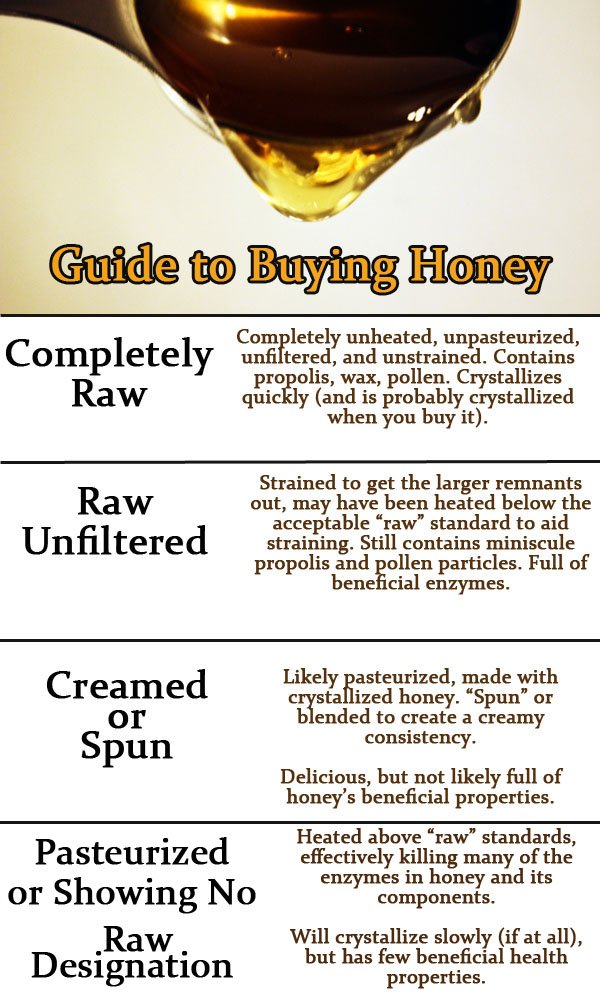
There’s one exception to the labeling rules: Locally farmed honey that you buy from the farmer’s market (the kind of honey I HIGHLY encourage you to buy). If you see some, ask the farmer about it. Ask how he/she filters it. How high they heat it. If they add anything to it. (You’ll probably like the answers they give.)
Speaking of heat: Information is conflicting on how high honey can be heated before it loses its rawness, and there’s no legal standard. Myriad online sources say different things, but the standard seems to be heating honey at a range from 120-140 degrees for 30 minutes to 160-170 degrees for 15.
So if you’re asking a local farmer, use those temperatures as a base guide on whether or not you want to buy their honey. (Remember, no heat or low heat is best.)
Important Honey Reminders
As if I haven’t just sprung enough information on you for the week, here’s a little more that you’ll want to remember when you’re buying and using honey:
- Do not give honey to babies under the age of 1. Honey contains a specific bacteria that (very, very rarely) may cause botulism in newly developing human beings.
- Honey keeps forEVER. Especially when it’s unpasteurized. There’s no expiration date on honey. Use it until it’s gone.
- Honey that has crystallized is still good. Just because it is granular doesn’t mean it’s lost any of its goodness. If you don’t like the granulation, put your honey container in a warm cup of water to soften it. (I’ve heard recommendations to microwave it … but, as we know, high heat kills what we want, so keep it away from the nuke-machine.)
- Honey is wildly antibacterial. You know this already; I’m just reminding you. This is why it’s great for your face, but it’s also a good thing to put on small scrapes (or acne lesions).
- Don’t be confused by clover, wildflower, orange blossom, buckwheat, etc. labels. While there is a slightly discernible difference in the taste of these honeys, they haven’t been flavored. When you see honey labeled as anything that sounds floral, it just means that these are the what the bees “fed on” before they produced the honey. Again – there’s a difference in taste, which might be a fun thing to explore! (I see honey-tasting parties in your future.)
This will conclude the lesson for today’s portion of the Crunchy Betty Honey Challenge.
You have learned a lot.
There is much to digest.
In the meantime …
How is Your Honey Washing Going?
HOLY MOLY!
So far, after two days, we have 200 people signed up for the very first Crunchy Betty Honey Challenge.
How is that even possible? How AWESOME is that?
Two-shiny-hundred new people walking around with gorgeous, glowing skin.
So how’s it going for you so far?
Any insights? Any tips to share? Loving your face yet?

 Wash Your Face With Honey: Take the Crunchy Betty Honey Challenge!
I’m typically to blogging and i really admire your content. The article has really peaks my interest. I’m going to bookmark your website and keep checking for brand spanking new information.
Dear Honey honey,
I appreciate your information. Very ideal and inspiring. A good piece of general knowledge.
Thanks Teo
Your style is very unique in comparison to other folks I have read stuff from.
Many thanks for posting when you have the opportunity,
Guess I will just book mark this web site.
For hottest information you have to visit world-wide-web and on web
I found this website as a finest web site for hottest updates.
my rule of a thumb: if a jar of honey is not labeled with a full name, address and a phone number of the beekeeper who produced it, I’m not buying it.
Hey ..can I Appy honey on my hair??..after expiry ..
Hi, I recently started using honey to wash my face and have noticed that after I wash I have small red lumps on my face n it feels a bit hot which I guess is an allergic reaction to it.
Now the honey I use is called Hilltop Raw British Wildflower honey…do you think that the wildflower is the cause of the reaction? Should I use another type of honey that is purely raw and unpasterized?
I am allergic to bees and usually have to use an epi- pen if I get stung. I’ve been using raw and unfiltered clover honey on my face for a few days and haven’t experienced any negative reaction to it yet. I am new to the whole “honey as a facial cleanser” scene so I did some research and realized that I want the 100% pure, raw, unfiltered organic honey with a firm texture(the clover honey i’m using is not solid). So I ordered it and am currently waiting for it’s arrival. Do you think this is safe to use on my face? When I get stung I don’t experience swelling in my throat but my eyes and face may get a bit puffy(not every single time).
Hi! I’ve been reading your web site for a long time now and finally got thee courage to go ahead and give you a
shou out from Humble Texas! Just wanted to say keep up the good job!
Why users still make use of to read news papers when in this technological globe the whole thing is accessible on web?
Can i use RAW CREAMED HONEY ? same as raw honey right ?? Same benefits??
Heyy umm i just bought the tesco value clear honey.. Coz it was cheap so i thought heck just gonna see if its ok for my skin.. I didnt no doff type of honeys had diff effects.. So u think i can use it? Will it still have benefits for acne prob ?? Clear.honey??
I really appreciate all the information you have provided about honey and it’s wonderful healing properties. I am currently trying to get myself and my boyfriend on a completely organic/home-made beauty regiment (yes, he does face masks with me). In addition to the honey, I would like to try the OCM, but am reluctant as my boyfriend and I have very sensitive, acne prone skin. Is there a recommended “mixture” of organic ingredients (including EOs, some sort of exfoliating grain, maybe?) that would serve best for our night-time regiment. I attempted a tincture of chamomile, green tea, oats, lemon, and carrot last night, but it did not turn out as I had intended. I have been no-poo for a month already, and have finally found the balance for my hair. I’m a little more weary about experimenting with mixtures on my face, so I could really use some guidance. Also, my boyfriend has really painful acne all over his back and chest, and I don’t want to put anything on it to make it worse. I’ll keep researching…but figured I would ask. I enjoy reading your blog, thank you so much!
Hi Crunchy Betty!! I recently found your website and I want to thank you for such a wealth of information. I started using honey on my face four days ago and my acne has literally cleared up immediately!! I use the YS Eco Bee Farm Raw Honey and I love it! Thanks for the detailed comparison in which honey to choose. Have a blessed day!
i have oily and acne-prone skin. i really want to try the honey face wash but unsure of what brand of raw honey to buy. the brands readily available at my local Sprouts market are “Really Raw Honey” and “Y.S Eco Bee Farm Raw Honey”. Are those good brands to start of with or can anyone suggest a brand they’ve used and has worked for them so far. thanks in advance!
Hi Minda,
I use the YS eco bee farm raw honey and have seen amazing results in just the four days I have been using it. This is what I already had on hand. I don’t think the brand matters just check your labels. Good luck and hth!
Hello.
Nice post. I used to be checking continuously this weblog and I am impressed!
Very helpful information particularly the ultimate section :
) I care for such information a lot. I was looking for this particular information for a very lengthy time.
Thanks and good luck.
Part of your statement about Raw Honey is incorrect. I harvest honey and sell it, Raw. It is not crystallized when I sell it. Some of my honey from last year is still not crystallized. While I filter my honey twice it is never heated.
Wonderful paintings! That is the kind of info that should be shared across the web. Shame on the search engines for not positioning this post upper! Come on over and visit my web site . Thank you =)
Hi betty..
I really want to try your honey wash and i whas wondering if the manuka honing is a great honey to use for this. I leave in holland and it’s so difficult to find a good honey because you don’t know if it’s pure/raw or not. Can you help me..
MAny thanks
samia
Hi Betty,
I was so excited to wash with hone tonight, after tracking down some raw honey! But while the honey was sitting on my face it started to feel uncomfortable in some places. After I rinsed the honey off, my skin looked and felt really irritated, and a little burning, and it’s all red and patchy. Should I give up on the honey, or keep with it? Will my skin improve? FYI – my skin is extremely sensitive and prone to roscea. I thought honey would be good for my skin??? Thanks!
Me too! I used raw Honey twice a couple of days ago and it is still irritated. Am back to just water and then raw Cocoa butter to moisturize and it is calming down.
I am up to this challenge. Today is day one for me and my face already feels better
This is the right website for anyone who hopes to find out about this topic.
You understand a whole lot its almost hard to argue with you (not that I actually will need to…HaHa).
You definitely put a brand new spin on a topic that has been discussed for decades.
Wonderful stuff, just great!
Excited to try honey face washing! Started back up on the OCM, but I want a little more, so I’m gonna try this in conjunction with my OCM routine. QUESTION… Anyone here from Florida and has tried Winter Park Honey? I definitely want to go local and raw to get the best benefits for my skin! If you have, what do you think of their honeys? I just ordered a local wildflower variety, and I can’t wait for it to arrive! You can check out their company and products here: http://www.winterparkhoney.com/
Crunchy Betty
I am quite senior but I am going to take you up on your Honey challenge
Love your Web site very easy to follow
M. doran
Today is my first day.I’m taking the challenge to wash my face with honey for two weeks. I know this is an old post but I’m excited to chuck my regular facial cleanser. I try to buy organic and all but I’d rather use honey. I also bought your book and love it.
Thanks so much and love your blog!
Linda<
I’m wondering if anyone can give me an example of a good facial routine for my situation. I have tried OCM and honey cleansing before and am planning to create my own moisturizer using Betty’s guide ASAP. Basically, I am suffering from postpartum and nursing skin. My skin has been mostly problem free my whole life, but since having my son 9 months ago, it has been more and more unpredictable and problematic. Dry/splotchy in some places and acne prone in others! No clue what to do anymore! Any advice or anyone who has been there would be a huge help!
THANKS!!!
I was told by a local honey bee keeper in Tampa that any local raw honey was good but orange blossom raw honey would his LAST CHOICE, AND ANY OTHER TYPE OF LOCAL RAW HONEY WOULD HAVE MORE LOCAL BENIFITS WHY i’M NOT SURE , BUT THAT WAS HIS OPINION AS HE TOLD ME IF HE HAD A CHOICE, HE’D ALWAYS SELECT ANY HONEY THAT WAS LOCAL RAW AND NOT ORANGE BLOSSOM. HE JUST MAY HAVE HAD A DISLIKE FOR IT AND NO REAL REASON BUT THATS WHAT HE TOLD ME AND I’VE ALWAYS USED IT AS A RULE OF THUMB.
i bought raw unfiltered buckwheat honey ,its crunchy !! so its also good at exfoliating
I swear to crunchy to wash my face for two weeks nonstop with honey.
Hi!!! I bought honey but not sure if its ok. It says if was strained but not filtered. It says raw pure on the label and on the back it says it was never heated over 115 degrees. Does this have all the fun benefits? Thanks!
Our honey has crystallized, so we threw it in the microwave (before we knew that was a bad idea). My sister found your earlier post and we washed our faces with honey for a few days. I looked at this post because I was curious about the benefits of honey, and now, after having heated the honey several times, am wondering if the honey has done anything at all. Is it positive that our honey is not worth using on our faces now that it has been heated?
After having tried a myriad a cleansers ranging from cheap to very expensive, I decided it was time to try a more natural approach to cleaning my 42 year old oil slick
face. Google led me here and I tried the OCM and just didn’t feel clean and experienced some breakouts. I then tried honey and the difference in my skin is truly amazing! I had raw honey from the farmers market and just used that and added a little baking soda at night to help with makeup remover. I have started following up with ACV/water at night as toner and then moisturize with a few drops of lavender EO mixed with a little grapeseed oil. My skin truly looks amazing; acne scars are almost gone, skin tone is even, no breakouts (none!), Melasma is lighter, no oiliness, and I went out in public without makeup on for the first time in my life ever! My 12 year old son and hubby both say they can see a significant improvement. Thank you so much for the helpful information on this site!
Hi everyone! I just started washing with honey using Simple Truth Organic Honey. Is this one okay to use? I assumed at first that this is okay but now I’m in doubt cause there’s nowhere in the label that actually says raw or pure. :/
It’s funny,I just called them to make sure it was in raw form. It is not. They told me they don’t pasteurize the honey but they warm it. I asked them how warm, their answer, 180 degrees. I was like oh so you pasteurize it then. Disappointing because the price is so affordable but if they heat it to the point that it kills everything good then there is no reason to bother with it.
Ok, so I have been struggling crazy with my face! Any thoughts are greatly appreciated. I have always had pretty clear skin, just occasional (small) breakouts. I have used Proactive for about 2 years. Anyway, I started the OCM a couple months ago and my face started to break out. I thought my skin was just transitioning, but it just continued to get more and more pimples all over! I have never had this much acne. I have since tried a couple different oils, and it isn’t getting any better. Being desperate, I tried putting tea tree oil and/or ACV on my pimples. Didn’t help too much and made my skin dry. I then put a mask (honey, cinnamon, and nutmeg) on my face three days in a row which helped a little. I have several big acne spots on my face that have been there for about a week and won’t go away. I also developed a monster of a zit on the side of my nose yesterday! My chest is also all broken out. I started washing when I wake up with just honey. (My honey says 100% pure, but I think I’m going to go buy some that says “raw”) My husband is not taking a liking at all to my new natural way of doing things. I am a no-poo convert and he complains that my hair doesn’t smell pretty anymore. Now with my face going crazy (new pimples every day), he is increasingly frustrated. Every day he tells me to go back to regular face wash and says that the natural way is doing more harm than good. I am very stubborn and I really want to use natural products but it is to the point that my husband is annoyed and I’m just getting embarrassed to leave the house!
Some suggestions — sorry if this all sounds a little disorganized but just saw your comment and wanted to get these out to you quickly 🙂
If you want to stick with OCM, the suggestions I’ve read for people who have had adverse effects are to stay away from olive and coconut for sure, and maybe jojoba, although many people think Jojoba is the bee’s knees. One person found that castor oil was the problem and switched to just jojoba. I know it’s frustrating because there are so many combinations of types/amounts of oil, and it takes time to test and see results, while your skin is a very visible guinea pig 🙁 I have only been doing honey and OCM for the last two weeks so don’t have a specific regimen/balance yet that I can suggest as effective long-term.
You may want to switch to just honey as a cleanser, until your skin chills out. Then, if you want to try OCM again in the future, start easing it back in by using only once or twice a week, and maybe spot testing with different formulations. Honey itself doesn’t get makeup off, though, so mix it up with something else to remove makeup (I’ve read suggestions of mixing it with clay, or using jojoba oil after the honey).
And here are some low-risk suggestions to help get your current skin problems under control (I didn’t want to suggest anything that may make it worse):
1. Keep exfoliating, but DON’T scrub too much since that can exascerbate the problem skin. My skin is so reactive I can’t scrub. I just started using a daily leave-on fruit enzyme exfoliating scrub, and a weekly fruit enzyme exfoliating peel, from MyChelle. There are probably other things you can make/buy that are effective. You may not need to do something daily just enough to slough stuff off.
2. Wash with cool or lukewarm water, not hot water. (I just started doing this and see the difference). Hot water can break down proteins in your skin.
3. Ice your face!! I keep an ice pack in the freezer (the gel ones made for your lunch packs are awesome) and apply it to my face at night after washing, before final moisturizing. I hold it on my face for 20 min, over especially the large breakouts, while I relax on the couch.
4. Put a dab of organic lavender essential oil directly on the current breakouts. It’s still a little drying but it has been taking down the size of my large bumps, as well as healing open breakouts.
5. Lymphatic drainage / massage: I’ve been too lazy to figure out the right way/location to do this, so I end up just doing a gentle massage all over my face, chin, under my chin, under my ears, on my neck and shoulders. You can research the proper method 🙂
6. Internal: Drink a BAZILLION glasses of water a day, and lots of anti-inflammatory red tea, (i drink mine with lots of the yummy raw honey that i am also now wearing), and/or other anti-inflammatory drinks and spices/foods , to help calm your skin down as well. And maybe detox tea!
For your hair — I also recently tried it and a very honest loved one commented that although my hair looked and felt very clean it did not necessarily smell that way:) Apparently hair holds on to smells, and the baking soda wasn’t getting it out. I’ve switched back to regular shampoo until I’ve had more time to research.
As a compromise with your husband, you could always temporarily switch back to regular shampoo (you can still get a good natural one) to let him enjoy smelling you again, to buy yourself a little more time figuring out your face:)
Hope this or something else you find helps you!
I have no suggestion for the skin stuff, but I have been no-poo since February and I think I finally have a routine that works for me. I was struggling with the scent part of not using shampoo and conditioner and didn’t like my manshape commenting on the pickle smell of my hair. For my ACV rinse I mix up a batch in a jar (actually I use a fancy glass vinegar dressing bottle, the kind with the little spout for serving at dinner). I just eyeball it, but it is probably about 1 tbsp ACV to 3 cups water. I add about 20 drops of lavender essential oil, 10 drops orange essential oil and about 1/2 tsp of organic vanilla, to give a nice scent to my hair. You could use different essential oils, depending on what fragrance you like. When I do my rinse I shake the mixture a little, as the oils separate from the ACV/water. I have found this to be really helpful in giving my hair the floral smell I liked from shampoos and my hair feels softer than when I was doing the straight ACV/water rinse. Good luck and I hope you find a routine that works for you (and your honey).
I am no expert but wanted to say that per the fda a product label can say 100% pure as long as 5% of it is! So chances are your honey has lots of fillers that could be causing the problem. Good luck in your journey.
Ok, so I have been struggling crazy with my face! Any thoughts are greatly appreciated. I have always had pretty clear skin, just occasional (small) breakouts. I have used Proactive for about 2 years. Anyway, I started the OCM a couple months ago and my face started to break out. I thought my skin was just transitioning, but it just continued to get more and more pimples all over! I have never had this much acne. I have since tried a couple different oils, and it isn’t getting any better. Being desperate, I tried putting tea tree oil and/or ACV on my pimples. Didn’t help too much and made my skin dry. I then put a mask (honey, cinnamon, and nutmeg) on my face three days in a row which helped a little. I have several big acne spots on my face that have been there for about a week and won’t go away. I also developed a monster of a zit on the side of my nose yesterday! My chest is also all broken out. I started washing when I wake up with just honey. (My honey says 100% pure, but I think I’m going to go buy some that says “raw”) My husband is not taking a liking at all to my new natural way of doing things. I am a no-poo convert and he complains that my hair doesn’t smell pretty anymore. Now with my face going crazy (new pimples every day), he is increasingly frustrated. Every day he tells me to go back to regular face wash and says that the natural way is doing more harm than good. I am very stubborn and I really want to use natural products but it is to the point that my husband is annoyed and I’m just getting embarrassed to leave the house!
Alright Betty- but you still haven’t concluded which “type” of honey is better for your face. I’m guess it should be dark. So which one- buckwheat, or bamboo? or what?
Hi CruncyBetty and friends!
Sorry for the weird question, but is the “pollen” that raw honey contains the same pollen that causes allergies? I’m not sure if I’m allergic, but I just want to be on the safe side.
I have SEVERE food and tree and all things nature allergies. My allergist actually recommended eating local honey to help build up a tolerance to the allergens in my area. But, I am not your doctor, so just try a little bit in moderation and see if that helps! (and if not then keep some Zyrtec on standby).
I LOVE your blog! I went from spending so much time at Sephora trying to find anything to fix my skin (oily, acne prone and huge pores) to paying tons of money for basically chemicals that did nothing. The first time I came into this blog (thanks to Pinterest) I am proud to say I am CRUNCHY, lol! I have tried most of the “recipes” here and I have never gotten so many compliments on my complection. I wash my face everyother day with oil (yes, I took your challenge Betty and you proved yourself right!) and the others with honey. Thank you for sharing and God bless!!!
I was wondering if manuka honey 15+, (I’ve found one which is raw yay!) would be any better than your average raw honey, it probably is it’s just it’s like 4 times the price:( But if it isn’t really than I would be happier just getting the average raw honey:) I have mild/moderate acne btw…it sucks.
hey just wanted to leave a comment as Crunchy Betty has changed my skin for the better, for life. I have been washing my face with honey, and the oil cleansing method alternating as needed for makeup removal and using baking soda as a scrub about 1 a week. for convenience sake I decided to buy a face wash to use when traveling. (I did travel with honey and my oil once and the results were less than pleasant. Im still trying to find the best way to store my honey for daily use as well as travel) let me say that using the face wash just once caused my face to break out, and my eyes to itch relentlessly for days. never again will i go back to drugstore/designer facewashes. thank you SO much Crunch Betty!!!!!! if you have any storage/travel tips I would LOVE to hear them!
Is unpasteurized pure honey ok ??
Of course! Pasteurization is meant to kill harmful germs, but the bees created honey to have antibacterial properties…which means that even if some virus gets into raw honey, it’ll be fine cause it won’t survive there for long.
I love your honey guide! Thank you so much!
I am considering trying the honey wash, however, I am concerned that it will have a bad reaction with my face (although I’m NOT allergic to honey). Is there anyone who has tried it and it has worked without probelms? Please let me know!
i’m 7 momths late but i love washing my face with honey! Back in october my husband was given a big jar of raw honey for doing some minor work on a snowmoblie for a women’s shelter in the mountains. it’s great! Still has wax bits in it. I keep a bit in an old hotel shampoo bottle in the bathroom. then it’s always in there. for the past week i have been using it every morning and my skin feels great. i hope to hit some farmers markets this summer and getr more!
hello, I came across your website searching for OCM and then i read your blog on honey. very informative since i already use a cold cream to cleanse my skin and ever since i stopped ive broken out for the badly and these pimples wont go away i started again ad my skin is glowing. I will try the honey bt its soo hard to find raw honey and its soo expensive. i want to point out that honey is not bad for babies. In my religion, it said that that honey has healing properties so eating honey in warm water and lemon on empty stomach first thing in the morning is the best thing you can do to yourself. When a baby is born, we feed the baby honey like not even a tiny drop. many eastern cultures practice this and i think its very healthy for the baby.
I haven’t checked my main large grocery store yet, but when I happened to be in a small Mediterranean store I quickly noticed their array of honey! Not *one* bottle was labeled as raw, which was frustrating. Per your exceptions though, there was a brand by local farmers that probably would be great.
Since I was aiming for raw though, I hit the jackpot. 😀 I found honey that was delivered — still in the comb! I figured that’s about as raw as it gets. Getting used to the honey wash, and will see how it goes.
All honey types are good, but polifloral honey is the best!
Manuka honey is one of the best types you can use! It is even more antibacterial than regular raw honey and has been used to treat staph infections, severe burns, etc. The only honey I know that is stronger than Manuka is Ulmo, but Ulmo has been much harder to find in the last year or so.
Using Manuka will make your two weeks even more effective!
Question, even though this is a month or so late. So the honey that I buy is said to be raw, and peeled right off the comb and put into a jar with no pasturization or anything. It’s yellow, sticky, has a creamy consistancy, and has honey comb pieces and other crunchy things that float to the top, that I have to stir in.
But it has NEVER gotten hard or crystalized?! I keep it in the bathroom, and it is just starting to get cool out, but should I look into another honey supplier?
If you keep it in your bathroom heat could be part of that reason. The coconut oil I keep in the bathroom is frequently slightly melty because of the location, versus oil kept elsewhere.
Also, I actually have a package of honey still in the comb sitting on my counter right now. Some areas are chunky, but others are perfectly smooth. If it has other pieces to stir in, etc, I can’t imagine it’s filtered in any way. Those would be the first things to go.
Good luck with your honey adventures!
Hey!
Where does Manuka honey fit into this scheme of things – it’s all I’ve got in the kitchen and I’m really having trouble sourcing some raw honey – it would be great if I could use this?
Thanks!
Ok, I am totally addicted to this. Probably staying with this after the challenge. 🙂
My honey SAYS pure, but Im not 100% sure. Some online sources say that the brand I use its strained a lot, to make sure theres no remnants in it, but heated REALLY REALLY low. But now I cant read the label for the brand. I think my sister tore it of. So….. Im trusting that for now. 😛
Does honey exfoilate at all? Because if it doesnt, I think I will do a honey wash in the morning, and the no nonsense scrub at night.
I’ve seen several comments mentioning the tiny bumps or “break outs” and I would like to know as well, if anyone can provide the answer. I’ve seen an increase in the time it takes to heal, which I’m very thankful for, and my older acne is clearing up quickly, but like others I’ve had a couple new ones pop up shortly after starting. Most of them are just really small white heads that aren’t becoming inflamed, but I’ve have one or two big ones arise. Is this normal? I find it completely weird because other than the new bumps I’ve noticed an improvement in my skin’s condition. It’s like you have to look past the acne to see that I have really great skin, it’s just camouflaged by bumps right now. Is this normal? And can anyone explain why it’s happening?
Pasteurization kills off all the good stuff. After that it’s just another sweetener. 🙁
So interesting to read this info about Raw honey. We provide raw goat milk shares and the process of pasteurization is almost identical in milk, killing good bacteria and destroying enzymes that make it a “whole” food. And in the regular milk industry, the way the animals are raised and treated REQUIRES pasteurization in order to “clean” the milk well enough that it is fit for human consumption. Yuck :p
I was able to get my honey Raw and Local, although it was from King Soopers lol 🙂 I didn’t have a chance to get to the farmers market to get it from Black Forest. I too LOOVE what it’s doing for my skin and how surprisingly easy it is to rinse off! YAY Betty!
question, i was just once told. the darker the honey, the more purer/raw it is?
I’m loving it so far!! I hope it helps clear up my skin, and in fact… has anyone had any breakouts while using honey? I’m wondering if it’s helping to clear up my skin by bringing things up to the surface. I’d love to hear your opinions or experiences with this.
I have what I think is probably a dumb question–I get my honey from my uncle, who is a beekeeper. It’s not crystalized when he gives it to me, but since it’s from a beekeeper and not bought from a store, does that mean it’s probably raw unfiltered?
That sounds about as pure/raw/unfiltered as it can get, but ask your uncle if he heats it or filters it. Wish I had an uncle who was a beekeeper! 🙂
I will ask! Thanks, Stephanie! And yes, I am definitely WAY lucky to have a beekeeper in the family.
I’m delighted with your blog! I’m a beekeeper….I love honey, and I love our *girls* (bees) more. Thank you for supporting and using “raw” honey and your local farmers. We have 100% pure,all natural,raw honey and it really depends on what type of nectar the bees collected as to how much or how fast the honey will crystallize. I never heat our honey and haven’t yet had any to crystallize. Keep up the good work and thank you again for giving the *girls* (Honeybees) a good word about their work…honey..it’s good for you! 😉
Oh thank goodness you answered my question. My honey is raw and crystalized and I wasn’t sure how to warm it up – so I’d been kinda slathering it on my face like a honey mask but now I know how to soften it up safely!!
Yay!!
Loving it, Betty!! My face is soft and acne free!
Thanks for the info on raw honey. I am not sure if it is in the grocery stores in my state. I have looked in the regular grocery stores and the natural food store and no raw honey. Do some states ban it?
Loooove this line: “newly developing human beings” — adorable 🙂 Honey washing is going; skin is not yet clear, but I have deep faith in crunchy things…
I have been loving it. I really want to wash my face all day just to feel the goodness. I usually leave the honey on my face like 5 minutes. I will floss my teeth, or somethng while I wait. It rinses off great. I am experiencing a few break outs~but hay it could be something I have eaten too. I just put a dab of honey on the spot. So far so good. Honey says “Pure, Natural Raw” on the label. Is this ok? It is clear no crystals etc.
In Ayurveda, it is very important never to boil, bake or cook with honey. it changes the properties much closer to poison
First off: MMM, MMM, GOOD. It’s fun to wash my face with honey.
My skin is freaking out right now, but in a good way, I think. Nothing scary, no sensitivity, dryness, or oiliness. There seems to be a lot of surface-level detox going on. And this in just two days!
I have been dabbling with the oil-cleansing method for a month or so but hadn’t been doing it regularly. Honestly, the honey challenge is what got me to start washing my face at night, every night — I wanted to have a clean face for the honey! (Okay, so it’s only been two days, but I am so happy that I trust in my momentum.)
So far, so good.
Thank you for posting this today! I recently purchased a big jar of honey that does say pure and raw on the label but is the regular consistency of most honey that you find in any store. Today I picked up a different honey that is fair trade certified, raw and organic. The consistency is really thick and maybe a bit crystallized so I guess now I know that would be my best choice for the challenge.
Also, I have suffered with staph infections (tested positive for MRSA). The last time I felt one coming on, I put honey on it the way I would neosporin or a similar product. NOTHING else healed it faster than honey and that was just using the regular honey you buy in the honey bear container. Within two days, it was practically healed. Normally it would continue to get worse and worse and last for days. Honey is now one of the main staples in my newly crunchy home and I recommend it to anyone that will listen. Even if they think I’m crazy.
I echo what someone else just said about moist skin (just posted about this challenge!!). I add a little water to my hands before rubbing them together and massaging onto my face. Otherwise I feel like the honey pulls and sticks too much. A little water adds a nice “slip” and feels great.
i have done this 3 days in a row and i’m loving it! i’ve had a reaction similar to that of few other people: my existing acne/scars have been healing RAPIDLY, but i did get one new pimple on monday night. however, nothing new since and the tiny guys at my hairline have completely disappeared, which i think is even more amazing because they didn’t get a full dose of the honey. 🙂 my nose feels like it could use a little scrubbing.
i don’t feel like i need moisturizer at all afterwards, but i have been putting on spf as necessary.
I started using honey just as my face started peeling from a sunburn, and it healed really quickly! This is the first time I’ve gotten such a bad sunburn, though, so I don’t know how fast it would heal normally, but I’m willing to bet the honey helped. 🙂
I found honey that said unpasteurized but not raw…would that be the same thing?
It probably means it was heated, but not high enough or long enough to be considered pasteurized. The wording / marketing is rather confusing on honey.
It is day 2 for me today and I love it. It has made my skin feel smoother, softer and more moisturized. I still need a moisturizer afterwards but it is much better than before. I have extremely dry skin so the added extra is great. Thanks for the challenge.
Hugs,
Debs
I did my first honey wash this morning, and like some of the other commenters I was pleasantly surprised that it washed off so easily! I was able to rub it on my face before getting in the shower and then wash it off once I got in, no problem. Very exciting!
Love lvoe love love love it. Feels amazing. I usually just rinse my face with water and pat it dry before applying the honey. I dont even us 1/2 a tsp to apply it….I use a 1/3 tsp measuring spoon and end up eating at least a bit of it 😛 Sooooo awesome.
I have Mountain Ridge “pure raw” honey. But what does “pure raw” mean?
Today is my third day of participating in the honey challenge and MY SKIN LOOKS AND FEELS WONDERFUL!!! It’s smoother, it feels cleaner and it glows….not shines but glows. I am a african american woman who has tried many many things to clean my face and this is by far my favorite. Sometimes if my face feels a little tight after then clean is completed then I will use just a little spritz of rosewater and aloe vera juice to tone and voila….my face feels lovely. I can’t recommend it enough.
While i have found it easier to apply on moist skin, applying and massaging it on dry face leaves the skin super supple after rinsing. Today i applied with damp hands on dry skin, seems easier to apply and massage well.
Me too… Damp fingers or it felt like to much pulling on my skin! But do love this and love the simplicity!!!
I’m loving it also!! My skin is feeling great and my acne is starting to clear up. The smell of honey is one of my favorites ever!
I also echo the wonderful comments. I have even starting putting a little in with my oats in the morning and i swear I will never go back to processed honey again. I lick my lips as well so I am sure they are not receiving any benefit but this stuff is wonderful. I am using the raw, unfiltered, unprocessed honey as well. AWESOME!
And i will be trying the no poo suggestions up there too since my hair is dry on the ends.
I friggin love this!!!! Not that I hated my skin care routine before (Black soap, then ACV toner, then a teeny dab of coconut oil if I felt dry), but this is soooo much simpler! One step: Wash with honey. That’s it! No need for anything else. I usually wear the teensiest bit of make-up, just concealor and mascara, but I’m keeping a clean face for now so I don’t have to fool with anything extra.
My honey is from a local family farm. SUPPORT YOUR LOCAL FARMERS!!!!
Thank you, Betty, for your honey explanations! Now, off to the Co-Op to buy ‘real’ honey!
So far so good here! I didn’t have raw honey so I just used what I had on hand and even that seems to be having a positive effect! I plan to hit up the farmer’s market today to see what I can find, though. I’m so glad you wrote this up, as I was asking these very same questions!
I also decided to use what I had on hand, Pure Honey. I’m having good results and saw a difference right away. After I use this up I will buy raw honey. Just being frugal.
I am amazed. After using the honey to wash my face, my skin feels clean without feeling dry. I have never experienced that before! In the past, clean has always been synonymous with dry. I am also totally blown away that a whole jar of honey still costs less than the chemical-y face wash I used to buy way back when. Also – It smells WAYYYYY better than any face wash I’ve used before! And if you happen to accidentally get some on your lips, there’s no icky taste 🙂
Ha! I find myself licking my lips because it tastes so good 🙂
I do the same!
MMMmmmm… I lick my lips, too… 🙂
I have decided that the honeyed-lip licking is my favorite part of my morning shower. 😀
Also, someone mentioned dry skin, so I thought I would share this awesome moisturizer recipe. I use it in the morning and at night. I has honey in it, so I don’t like to leave it on my face. What I do is apply it all over, let it sit for a minute or two, than splash just a bit (and mean just one splash) of cold water on my face and it leaves my skin perfect. Just be sure to shake the bottle before you use it to mix it well.
Daily Moisturizer:
This is a light moisturizer that I love. It is not a cream, soaks right in, and is the best one I have ever used. I mean that. I tried it over the winter and it worked beautifully. Now that it is summer, I still love it.
3 Tablespoons Avocado or Wheat Germ Oil
3 Tablespoons Honey
1 oz Vegetable Glycerin
1/2 oz Rose Water
1 oz Witch Hazel
Mix it all together and store in a small squeeze bottle. Shake well before using and pour a very small abound into your hand, use all over your face. I let it sit for a minute or so and then splash a bit of cold water on my face.
I will have to try this. I have extremely dry skin. Thanks for the post.
Hugs,
Debs
The honey wash is going great. I’m using Raw Unfiltered Wildflower honey and it feels wonderful and smells even better. I have had to moisturize afterwards because I’m living on a tropical island and the sun is brutal here. The spf is much needed. I think I’m going to try the no ‘poo’ shampoo while I’m on a roll with the honey!
Hey, I LOVE the no ‘poo. Here’s some advice. Wash your hair with the no ‘poo method as you need to. Don’t wait several days if your hair is getting oily. I found that was the way to manage the oils and it never went yucky on me. Also, do a final cold water rinse on your hair after you are done. It helps close pores and reduce oils. Finally, some people have mentioned over time that their hair ended up dry on the ends. Here are two great solutions (do them both). First, add a Tbls of honey to the vinager solution (I also add lemon grass and orange EO and it completely masks the smell). Second, when you are done washing, spray your hair all over with distilled aloe juice (This is what I use: http://amzn.to/2aB7eY3) This aloe juice has no preservatives, nothing added and does not make your hair stick or leave a residue. I have tried other kinds of aloe and they don’t work like this one). The aloe is the same PH as your hair (acidic), plus it is wonderfully softening.
Do these things, and I think you will not have some of the problems that others have with no ‘poo.
I’ve also found that when my hair feels extra gunky (like after a run), if I make a thicker baking soda paste, the end result is still clean hair. I use the recipe for conditioner found here: http://mamataneyskitchen.blogspot.com/2009/03/homemade-conditioner-for-your-hair.html – it’s a variation on the ACV theme (with beer – we like beer a lot over here, and this is a good recipe for those poor dead soldiers).
The no ‘poo was the best decision I’ve ever made for my hair – it’s always been flat and boring – now it actually has body. I love it.
That was TOTALLY off topic, hey?
Okay, first off let me say that this is the best timing ever. EVERY. Not only did I get my wisdom teeth out yesterday (I usually alternate between honey and oil cleansing and I really don’t want to be going after my face with a washcloth right now!) but I am driving to Maine next week then flying back. With the honey, I don’t need to bring a moisturizer and I’m not toning or wearing makeup on principle to give this thing a truly fighting chance.
Not that I feel the need to wear makeup!!! <<that is my favorite part. My skin is so soft and soooo clear, and this big raw patch under my chin (painkillers+low blood sugar=SORRY, no balance for Lissa today) is going away SO FAST.
I have to say that it is wonderful! Have used hone before on my face, but not exclusively and not as a daily wash. I think I’m hooked! I don’t wear a lit of make-up, but when I do I just clean with oil and then follow with honey. In fact, I’ve been making sure that honey is the last step to my face care. If I use a clay mask, I end with honey. If I want more scrubbing, I add a bit of baking soda. I love my skin right now. Also, I have just started taking 2 Tbls of flaxseed meal daily (started with the honey challenge) and I really think that this is helping as well. I mean day and night results! I have small flesh-colored, sometimes white, bumps on my forhead that have not gone away…until now. I think the honey’s antimicrobial and moisturizing properties combined with the anti -inflamitory properties of flax have been the cure. I’m seriously impressed.
BTW, I would take fish oil supliments, but I’m concerned about the overfishing going on, so I hate to contribute to that. I doubt that fish oil is produced in a sustainable fishing situation. Just too many fish needed. Plus, I like the other benefits of flax (fiber, vitamins, iron, etc).
I’m loving it! I think I got the completely raw honey (oops) – it wasn’t completely crystalized, but it has royal jelly and all that other goodness in it. Doesn’t matter – it’s hot enough here in Arizona that it’s melty when I open the jar (weather also helps keep coconut oil liquid at “room” temperature – bonus!). This morning after my shower my face felt a tiny bit dry, but that’s all good now (we also have terribly hard water here in AZ – urgh).
I love this for its simplicity and for how good it smells. I stopped using perfume a while back when I realized that it probably (ha!) wasn’t helping ease my eczema, and now I think I smell even better – like a coconut-y, honey-y goddess!
This is FUN!
Love, love, love! I’ll never go back to commercial face wash again! I love a good scrubbing face wash so the raw honey is perfect. Like others have said I also don’t need moisturizer but my skin isn’t oily either. It’s magic 🙂 I have still been using my night moisturizer but only until I have a chance to go get some jojoba oil to use instead. I have had a few bumps pop up here and there but nothing major and it’s not effecting the texture of my skin.
On a side note – I made my own body oil last night (ylang ylang and sweet orange) and it’s FABULOUS!!! I’m 29 weeks pregnant and ran out of belly cream. The body oil is 100 times better…again no more commercial lotions for me! I’ve also stopped taking medication for my heartburn and am trying ACV instead. Yesterday went pretty well with that. I read here last night about possibly using coconut oil so I’m going to give that a go too. I get crunchier every day and I’m loving it 🙂 Thank you, Crunchy Betty!!!
Amy, when I started transitioning into a crunch lifestyle I was taking prilosec every single day and if I didn’t, it would quickly catch up with me. I found for me personally that putting a little bit (maybe 1/4 tsp?) of Bob’s Red Mill baking soda in a glass and then putting in the ACV to fizz up before adding water was the best. Do what works for you. I did that for several days and it’s been several weeks and now I rarely ever have any acid reflux flare ups. I did last night because I indulged in pizza but other than that, I’ve been doing really well. Also think that changing my diet so that I have very little carbs has helped. I wish you the best with the ACV.
~~~Local Honey Rules!! ~ Support your local bees!!~~~
I have been having the same experience as KarinSDCA. I have a lot of little bumps coming to the surface. It is not ugly, it is just different.
Going well but skin a little dry this morning after my honey routine. Iam 52 and it is winter here in Australia. Got a little in my eyes this a.m. – a bit ouchy byt wshed out easily. Away on an overnight work junket tomorrow night and have packed my honey – will share my beauty routine in the communal bathrooms Sweet Dreams all x
First, I’m shocked that I’ve stuck with it for 3 days already (I’m usually not so dedicated).
I’m noticing that my skin feels much softer and did so on Day 1! Like KarinSDCA, I’m noticing some bumps/pimples come to the surface. However, most of the pimples that I had on Day 1 have either completely gone or are disappearing faster than normal. I also have an ugly, red acne scar on my left cheek that’s starting to fade. SO LONG PROACTIVE! HELLO HONEY!!
I bought Tropical Traditions Raw Honey. It is creamy like Peanut butter. My poor husband tried to use it for his coffee b/c it was on the counter and I smacked his hand. I suppose I’ll let him enjoy the good stuff after the 2 weeks 🙂
It’s actually rather fun to see how quickly honey can turn from liquid to completely solid. 🙂
I must confess that yesterday I was away from home and couldn’t wash my face with honey. That’s why today I’m letting it sit for a longer time, to feed and heal my skin a bit more. 🙂
I LOVE how easy it is!!! I thought for sure it would take for-ever to rinse sticky honey off my face. Ha! Two splashes of tepid water and my face is clean and supple without a trace of the honey. No need for moisturizer most of the time, either. I haven’t been using the honey directly around my eyes, so I have been using my usual homemade eye oil at night. I have been skipping it in the mornings, though, since my eyes still feel well-hydrated. My face feels so good — neither oily nor dry anywhere. This IS summer, right?
I do have some bumps right at the moment, so I am wondering if the honey is drawing out the impurities just under the skin’s surface? I’ve been doing the honey wash with raw, unfiltered local honey since Sunday evening. (It is crystallized, but I imagine it as a mild scrub.) Visually, my skin looks better than ever. Feeling it, though, I can feel all sorts of tiny bumps. Hmmm…
Hi I’m wondering if it is crystallized, how do I apply onto my face to wash every morning? Please help