
Shoot. I do declare the next few days Historic Beauty Days at Crunchy Betty. The ye olde beauty shoppe bug hit me last week, and I haven’t been able to stop reading since. Here’s why.
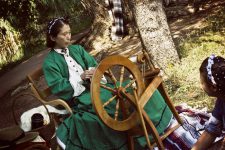
For the 4th of July, we did a little something different. My parents and I sweated it out at Rock Ledge Ranch, a historical site about a mile from where I live. There, they reenact the olden days, and, par for the course, they had a special 4th of July shin dig, complete with George Washington, Abraham Lincoln, and more pioneer and 1800s ladies than you can shake your bloomers at.
As we moseyed across the history-strewn grounds, I made it a point to ask some of the historical reenactors – mostly the women – if they knew of any beauty tips and tricks that our ancestors used during the Revolutionary War.
Paltry was the reply. Apparently, while perfect recitation of the exact ways to load a musket has been passed down through generations, the methods in which the ladies cared for their skin was not so thoroughly remembered. Boo.
For the record, the answers were, in no particular order:
- “They used a lot of pig grease on their faces, until they realized that wasn’t very smart.”
- “Lemon verbena. That was a perfume of choice.”
- “Hm. They probably used a lot of herbs!”
To be fair, the lovely ladies did promise to do some research and get back to me (and they WERE ever-so lovely), but I’m impatient. I took to the internets to find historical information, and after two days of coming up with very little, I hit the jackpot.
I figured, if I’m this excited to find ye olde ways to approach skincare and household upkeep, you will be too.
So, little by little this week, I’m going to share some of the fun things I’ve found on this historical (if not a bit obsessive) journey.
Today, I just want to share one little recipe that, for some reason, is so extremely exciting. Because even though the ingredients sound so very out of reach, after much research, I’ve found out we can do this exact thing.
Hop along with me.
“A Cure For Freckles” or Rose Complexion Masque
After much searching, I could only find two recipes for this, but one is highlighted in the book Women In Early America: Struggle Survival and Freedom In a New World.
From the excerpt: “A clear, pale complexion was highly priced in colonial America. The following was taken from an 18th century book of beauty advice (Beauties Treasury; or the Ladies Vade Mecum):
A Cure For Freckles
- Two drams honey of roses
- Two drams oil of tartar
- Mix with rye meal and spread on a cloth. Place over your face, breasts, or hands overnight. In the morning, rinse away with lemon juice
Drams of honey of roses?
Drams of oil of tartar?
What IS all this craziness?
Well, it turns out, it’s very easy to make BOTH of these things, much exactly as they made them in the 18th century. Let’s take it step by step.
A dram: A dram is basically 1/16 of a fluid ounce. Really, the total amount isn’t all that important here, as we know we need to use equal parts of both things. So, technically, you can just ignore the “dram” part. If you have to know, though, 1 fluid dram is just about equal to 1/4 of a tablespoon.
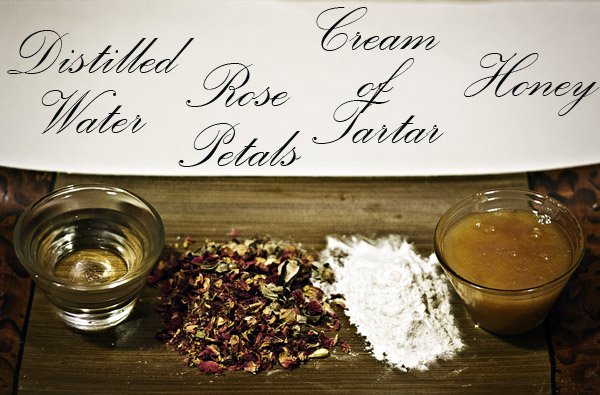
Honey of Roses: This one took some digging, and was a bit confusing. Is honey of roses just honey that’s made by bees feasting on roses? Or is it roses steeped in honey? Or what? Well, it turns out, it’s basically a steeped, filtered rose tea with honey added to it. I couldn’t find an exact recipe for it, so we’re going to improvise:
- Boil 1/2 c. of water (preferably distilled)
- Steep 3 Tbsp rose petals or rosebuds in the boiling water for 5 minutes
- Strain the roses from the rose water
- Add 1/2 c. honey and stir
- Voila: Our new-fangled honey of roses
Oil of Tartar: Again, this wasn’t easy to figure out. In fact, no one actually sells oil of tartar. It seems to be because there’s no such actual oil. The only recipe I could find was rather tricky and very old-fashioned (mainly because it used tartar directly from old wine barrels in the quantity of several pounds). So here’s our updated version, to be more conducive to a fun old-fashioned beauty party.
- Fill a small spice bag with 1-2 Tbsp cream of tartar
- Place it in 1 c. of boiling (preferably distilled) water
- Boil until the water is reduced by about one-third
- Remove the sack of cream of tartar
- You now have a new version of Oil of Tartar
From the link above that told us how they made oil of tartar, here’s a fun quote: “…on the skin, it removed dark marks or freckles, and it will make the skin lustrous and clear and stretch out every wrinkle. It will make you appear younger than you are.”
Most interestingly, oil of tartar was also used to remove stains on cloth and clean paintings. Anyone want to give that a try?
Rye Meal: For this, you can just ignore the “meal” and substitute the word “flour.” They’re basically the exact same thing. Rye meal, back in the day, might have been a bit less powdery than the rye flour we have at our disposal today, but it’s so similar there really is no difference. You can find it just about anywhere. Just check your local grocery store. Or, in a pinch, garbanzo bean flour or rice flour would do the same duty.
The Cloth: If I were doing this, I’d cut out nose holes in a piece of cheesecloth and spread the masque over that, and then apply it to my face. You, however, can do this any way that feels comfortable to you. I would not, however, cut out breast holes. (Because I won’t be putting this on my decolletage.) But, honestly, I don’t see any reason why you can’t just spread the paste on your face (or chest or hands) and leave it on like we would a normal mask. You do what feels right to you! Want to be historically accurate? Use the cloth!
The Lemon Juice: I’m pretty sure you don’t need me to define this for you. Except I will add this: I probably wouldn’t rinse my face with pure lemon juice (ouchie dryness). Instead, I’d put about a tablespoon of lemon juice in 3 cups of water and rinse that way. Either way, please do not forget that lemon juice makes your skin photosensitive, so steer clear of the sun for a few hours after doing this.
Will This Work?
Let me reiterate: I have not tried this personally, so I cannot attest to its performance in removing freckles or “making the skin lustrous and clear and stretch out every wrinkle.”
I will say this, though: Cream of tartar (which is what they get when they clean out old wine barrels, and comes from grapes) is on the acidic side, as is the lemon juice you’re supposed to rinse your face with. Will it lighten your skin? Most probably.
But it will probably also make your skin rather sensitive (and photosensitive, or easily burned in the sun) if you include the lemon juice rinse. If you have dry skin, skip the lemon juice rinse. The cream of tartar (or oil of tartar), probably won’t cause irritation, as straight cream of tartar has a pH of about 5 (remember, pH 7 is neutral).
To update the application of this mask in terms of time, when I actually get around to making it, I’ll leave it on for 20 minutes and then rinse my face with distilled water.
What do you think? You want to get down and dirty with the historical beauties?
Do YOU know of any exceptional historical beauty tip, home remedy, or household sites for the ladies? Any old books we should all peruse for fun and enjoyment?
(OH! PS. Way back in September, we talked about a few old beauty recipes, as well, in Generations of Learning. If you want to get a jump on things, check it out.)



I actually got started with making my own cosmetics and beauty recipes with medieval recipes! Combining historical wisdom with modern knowledge is my basic MO when it comes to formulating.
To find those old beauty recipes you need to scavenge through recipes for food and medicines. The Italian ‘Book of Secrets’ were widely published by many noble ladies with the birth of the printing press and have many such recipes. Hugh Platt’s “Delights for Ladies” is English and focuses on the beauty recipes. Cosmetics were considered medicines for most historical time periods (including early American) which is why it was perfectly normal for men to use them as well as women. If your complexion needed brightening it didn’t matter what your gender was. Beauty was considered the ultimate sign of health, going all the way back to thoughts of Greek and Roman doctors who are the founders of our modern medical tradition. Earlier beauty recipes are almost exclusively in medical manuscripts. I have a small collection, feel free to send me an email and we can share recipes!
Thanks for finally writing about > Historic Beauty Days: A Cure For Freckles or Rose Complexion Masque | < Loved it!
This page certainly has all the info I needed about this subject and didn’t know who to ask.
You really make it seem really easy with your presentation however I
in finding this topic to be actually something that
I think I’d never understand. It seems too complex and very huge
for me. I’m looking forward in your next put up, I will try
to get the hold of it!
There’s definately a great deal to know about
this topic. I like all of the points you’ve made.
Yes! Finally someone writes about music maniac music d.
This paragraph is truly a pleasant one it helps new internet visitors, who are wishing for
blogging.
This piece of writing is genuinely a pleasant one it helps
new web people, who are wishing for blogging.
Right here is the perfect blog for everyone who
hopes to understand this topic. You understand a whole lot its
almost hard to argue with you (not that I personally would want to…HaHa).
You certainly put a fresh spin on a topic that’s
been written about for ages. Wonderful stuff, just wonderful!
magnificent points altogether, you simply won a logo
new reader. What may you recommend in regards to your submit that you just made a few days ago?
Any certain?
Betty, I just found your site a few nights ago and applaud you enthusiastically. I’m interested in finding food or oil that’s best for my eye tissues (below and lids). I’m 51 and have begun the stage of degeneration that can be a bit of a robber of my best feature. I have read about the egg membranes, but haven’t yet found anything for under makeup. That area is so much more delicate than the rest of my skin that I’m not 100% sure if I should use the same creams and lotions for the eye area. Many many thanks, linda
I stumbled in her because I was searching on “Beauties Treasury; Or the Ladies Vade-Mecum”. I know it has been a while since you wrote this, but if you are still interested, then you can find some information on my blog. I can also recommend Google Books for finding historical beauty recipes.
Sounds amazing. I’ve always hated my freckles, and always envied the girls without them. I might just try this sometime(;
Betty, since you wrote that you don’t know how to convert from Celsius to Fahrenheit, please note the following example of 20 degrees Celsius. Divide 20 by 5 = 4 multiply by 9 = 36 add 32 = 68 degrees Fahrenheit. From Fahrenheit to Celsius, do the reverse. I learnt this in Holland in 1948 in school when I was 11 years old. Talking about developing a crunchy mind and not being preoccupied with one’s looks.
When I was 11, I was learning that if I couldn’t say anything nice, I shouldn’t say anything at all.
The Library of the Wellcome Institute for the History of Medicine has digitized many of their books and made them available online (http://library.wellcome.ac.uk/node9300909.html), where you can download them as pdfs. “A booke of physicall receipts” (1650) (Western manuscript #6812) has mostly medical recipes, but there are a few beauty-related ones:
Bean flowers water, p. 27:
“For makinge of the beane flower water you must at the tyme of the yeare take halfe a peck of beane flowers & as much of wild tyme & steepe them a whiles in milke & so let it be distilled.” (I googled bean flower water and apparently this was used as a facial wash or toner. What with the thyme and lactic acid in it I imagine it would be quite a good toner.)
To get good colour, p. 78:
“Steepe some wormwood in beere over night and drinke it in the Morninge before your bodyes [i.e., corsets] be laced then take some parsley & boyle in some milke & when it is ready put in a little butter & dreinke it an hower after you have drunke the beere.”
And our old friend honey of roses, p. 32:
“Take of the juice of red roses & of good hony of each a like quantety boyle them togeather on a softe fire to the substance of a sirrupe.”
I wash my face with oatmeal and moisture with coconut oil. I bet the rye flour alone would do something valuable. 🙂
Crunchy Betty needn’t worry about lemon juice and photosensitivity or dryness. Lemon essential oil, or more correctly, the expressed oil from the peel of the lemon contains furanocoumarins which are phototoxic, but not the juice. In addition, the acidity of the juice acts as a mild exfoliant (fruit acid) and helps soften the skin by loosening and dissolving dead skin cells. It will not dry out the skin any more than water, so it’s best to follow up your 18th century treatment with a nice emollient (virgin cold pressed coconut oil).
Check out “The Toilet of Flora;” the ebook is available to read on Google.
I love to hear that there are women out there that love their freckles…I, on the other hand have always wanted mine gone. I just might try this soon…I love the thought of the history behind all this…Keep it coming!
be still my heart! you’ve just combined two of my most favorite things into one post…historic preservation and home remedies. hooray!
On my blog I posted a hilarious list of “frontier fixes.” Some were gross sounding remedies (Baldness: “Fertilize” new hair growth by smearing cow manure on head.) while others were very superstitious (Toothache: Spit into a frog’s mouth, and ask it to leave with the toothache). The list was originally in the Farmer’s Almanac. It’s worth a read.
http://wifelife2011.blogspot.ca/2012/01/frontier-fixes.html
Love this! Your recipe posts are my absolute favorites. I owe much of my personal care “products” to your site. My skin and wallet are better for it. Bring on the olden days!
I like my freckles! But I love reading about olde-timey things like this! Looking forward to rest of this series. 🙂
while interesting, I have to say that I love what few freckles I get in the summer time! I’ve always been envious of girls with freckly noses and cheeks!
This is fun! I love learning about historical beauty techniques, that said I love my freckles and would like to keep them. 🙂
From now on, I will have to remember to don ye olde pair of depends before reading your blogs. I almost wet myself at the thought of you cutting out “breast holes” in the cheescloth! By the way….did the faire ladies back then refer to them as breasts?
Barb, I absolutely love that comment. You have me cracking up :O! CB is the best, I can’t have enough of her site; her knowledge, the simplicity in which the explains the processes, anyone can understand them, and her humor…how do you describe that…she’s simply amazing. Keep up the good work CrunchyBetty!
I’m a 19th century women’s and cultural
historian, so most of my knowledge of historic beauty regimens begins in the
early 1800s. However, there are some extant sources that I think are kind of interesting
and can still be useful (even if only for better understanding some of the culture
and society in which our foremothers lived).
Oftentimes beauty tips and recipes were included in both
cookbooks and etiquette books, but these are some of the most solely beauty
focused ones I could find at the moment. While these sources are more for
understanding the cultural history of beauty (and women’s position in society
in connection with beauty and femininity), and the progression of “acceptable” measures
taken to achieve or maintain beauty at various points of time and as part of a
particular culture, some of these recipes are still useful. However, others are
downright impossible; primarily because 1) many of the ingredients are no
longer available today, or 2) some of the ingredients have been proven to be
harmful (i.e. though mercury was touted to cleanse the body and complexion of
impurities, it’s extremely toxic).
Dean, Teresa H. How to
Be Beautiful, Chicago:
T. Howard, 1889.
Kingsford, Anna, MD. Health,
Beauty and the Toilette, London:
Warne and Co, 1886.
Montez, Lola, The Arts
of Beauty, New York:
Dick and Fitzgerald, 1858. (Madame Lola Montez, the Countess of Landsfield, was
a premier lecturer and authority on Women’s fashion and beauty in the mid 19th
century.)
Reed, I. N. The Ladies’ Manual, Chicago: I.N. Reed and Co., 1883.
Powers, S. D. The Ugly
Girl Papers, New York:
Harper and Bros., 1874
Sylvia’s Book of the
Toilette; A Lady’s Guide to Dress and Beauty, London: Ward, Lock and Co., 1881.
The New Family Book;
or Ladies’ Indispensable Companion, New
York, 1854.
Walker, Donald.
Exercises for Ladies: Calculated to Preserve
and Improve Beauty, London: Hurst, 1836.
There are many, MANY more, but all of these can be easily
found and downloaded from Google books. Given time, I could dig up more
information on beauty from the 17, 18th and 20th century :
) If anyone would be willing to take over my jobs for a few weeks, I could get
it done in no time! : )
interesting recipe and glimpse into history but i like my freckles. ^____^
Haha! Me too. Plus, I have waaaaaaaay to many freckles for something like this. I’d have to take a bath in it. 🙂 Very interesting though!!
Glad I’m not the only one who likes her freckles! I think freckles are adorable.
What a good idea for the week! This should be very interesting. I wish I had some crunchy grandmothers to talk to about their skin, but alas, I do not. No contributions from my end, but I’ll enjoy reading these posts!
I have been thinking for a while that this is a fabulous premise for a book. As a SAHM who is always looking for ways to do things myself in a more natural manner, I keep wondering how it was all done before the invention of all things packaged and processed. I freakin’ love your blog, BTW.
This is so fun; I may or may not try it but I love old beauty recipes! Especially when they’re presented in a format that’s actually doable (and with the dated bits ‘translated’). Thanks!
I love this post! I’m working at Monticello this summer and every time I walk in the gardens, I’m just so curious what was being used for personal care routines, etc. I know Jefferson did a lot of his own healthcare for himself as well as family and slaves, so I’m sure he sent for all kinds of interesting plants to make his remedies.
My question is, can you explain distilled water to me? How do you use it? Do you only wash your face with distilled water? Why is that important? How can I start? Do you buy it/make it? How do you store it? Etc. I’m fascinated by this idea. Thanks!
http://www.getcleangirls.wordpress.com