
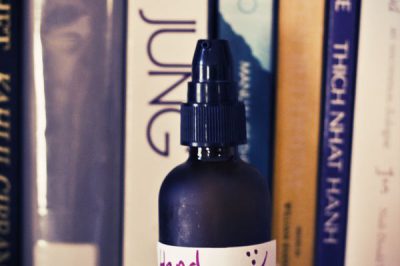
Soap and water get your hands clean, but there are just some days where you need a little extra.
Like when you’re driving across the state of Kansas and have no other option but the rest stop in the middle of nowhere, and best-case scenario what’s on the wall is the remainder of a burrito from the road-side stand 10 miles back.
Yep. That’s when you want some hand sanitizer.
If you’re going to sanitize, why not make it work for you in three different ways? Kill the germs, soften your hands, and enjoy mood-enhancing aromatherapy.
And you know what? Hand sanitizer is ridiculously easy to make, and there are a lot of pros to doing it yourself as opposed to buying in the store. There are also a couple of cons.
So let’s go over the reasons you’d want to make your own hand sanitizer first, the reasons you might not want to, and then we’ll look at the recipe I think is best.
Pros and Cons to Making Your Own Hand Sanitizer
Pros:
- You know exactly what’s going into it and there are no nebulous ingredients like “fragrance” (which usually means “whatever other chemicals we feel like throwing in, plus some synthetic scents” on a product label)
- You can turn it into aromatherapy, at the same time bumping the antibacterial action up a notch with essential oils
- You can make it so much more moisturizing than the store-bought alternatives
- You’ll be able to use the excess ingredients for dozens of other homemade beauty and skincare treatments
- After you make it, you might go on a walk and come home with a baby kitty (at least, that’s what happened to me today – I assume it’s related)
Cons:
- It’s a bit more expensive to make your own than to buy the cheap stuff like Purell or Germ-X
- You have to get the alcohol/other stuff ratio just right in order to ensure proper germ-busting (at least 65% alcohol content is what you need to shoot for – recipe below is more than that)
So, for me, the pros outweigh the cons by a good bit (wait until you see the kitty – you’ll agree). However, there is one more thing I need to mention:
Keep any hand sanitizer – homemade or store bought – out of the reach of children. While doing research for this, I was perplexed by the amount of “Warning – Danger” articles there were about children drinking hand sanitizer. I can’t even begin to imagine why they’d ever, in their tiny right minds, want to drink that stuff. But I also don’t understand why my son buys Japanese-language versions of Pokemon games and then cheats with online walk-throughs. Kids are weird.
Originally, my thought was that this was going to be a hand sanitizer for kids article (highlighting the fun idea to turn it into a bubble-gum scented concoction), but a) Because I’m not a fan of synthetic fragrance, I’m not going to promote synthetically fragranced recipes here and b) What kid wouldn’t want to drink something that smelled like bubble gum? THAT, I understand.
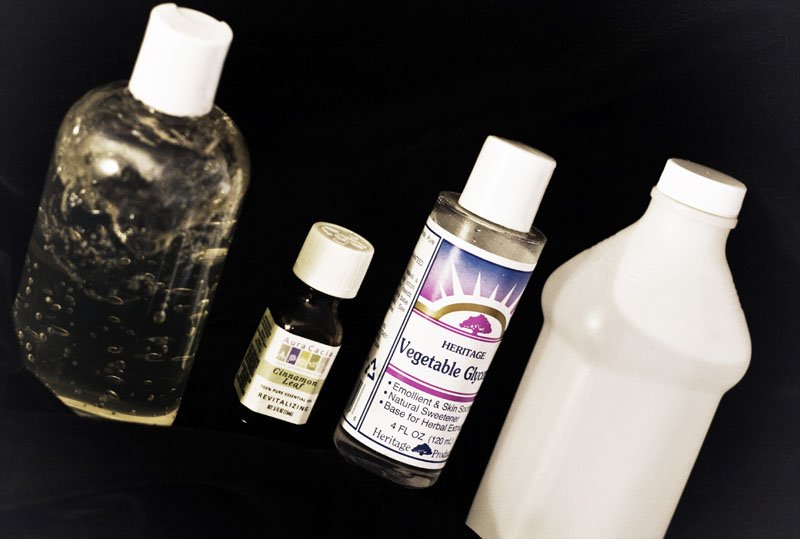
Homemade Hand Sanitizer Recipe
- 1/4 c. aloe vera gel (as pure as you can get)
- 3/4 c. rubbing alcohol (at least 91%)
- 1/8 c. vegetable glycerin (optional) (if omitted, use an extra 1/8 c. aloe vera gel)
- 10 drops essential oil (cinnamon and sweet orange were my choices, but there’s a list of other ideas below) (optional)
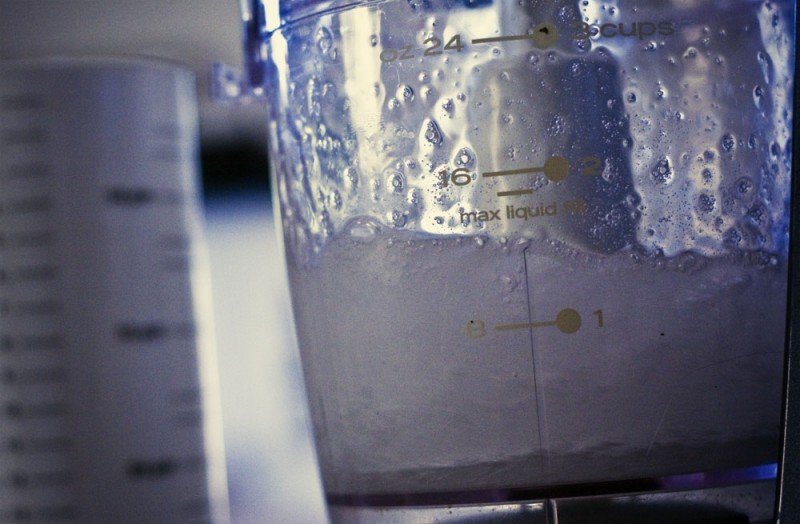
Pour everything into your food processor or blender and let it go on high for a minute or two. Bottle and use as you would any hand sanitizer. Keeps for 6 months or more.
This recipe was enough to fill the bottle in the picture at the top of this post, plus another one exactly like it. Plenty enough for our family to get through the winter months, given that I don’t condone the use of hand sanitizer more than once a day (if that, even).
What’s up with the glycerin? I added glycerin to to mix to add extra softening. The original recipe I adapted this from used more glycerin, which left my hands sticky, so I fiddled around with the amounts and ended up with something that’s both softening and effective – without leaving your fingers stuck together.
Aromatherapeutic Hand Sanitizer Options
So you can just use the aloe vera gel and the alcohol and have a perfectly good hand sanitizer. But why stop there, when you can make it work double duty? Here’s a list of antibacterial and/or antiviral essential oils and how they can affect your mood/nerves with their wondrous fragrant action:
- Cinnamon: Reduces drowsiness, enhances concentration, may decrease headache pain – one of the most antiseptic EOs out there
- Lavender: Relaxes, rejuvenates, relieves headaches and migraine pains; a good choice if you’re going to use it on kids (over the age of 2), as it induces calmness
- Lemon: Rejuvenates, helps ease depression and sadness, energizes
- Peppermint: Calms frazzled nerves, energizes, improves mental clarity
- Tea Tree: Maybe not the best-smelling option, but it’s VERY antiseptic and antibacterial – use this if you care less about the smell and more about nuking the germs – but tea tree oil does promote calmness and mental alertness
- Rosemary: Extremely effective in helping with information retention, alertness, and memory (I can’t live without this stuff)
- Geranium: Milder, but the most floral of the bunch: Lifts moods, eases PMS, promotes relaxation
Those should get you started. If you want to combine any of the above with another essential oil, that’s okay, too. Just be sure to keep it at 10 drops of EO or less, so you don’t irritate your skin.
What’s Her Name?
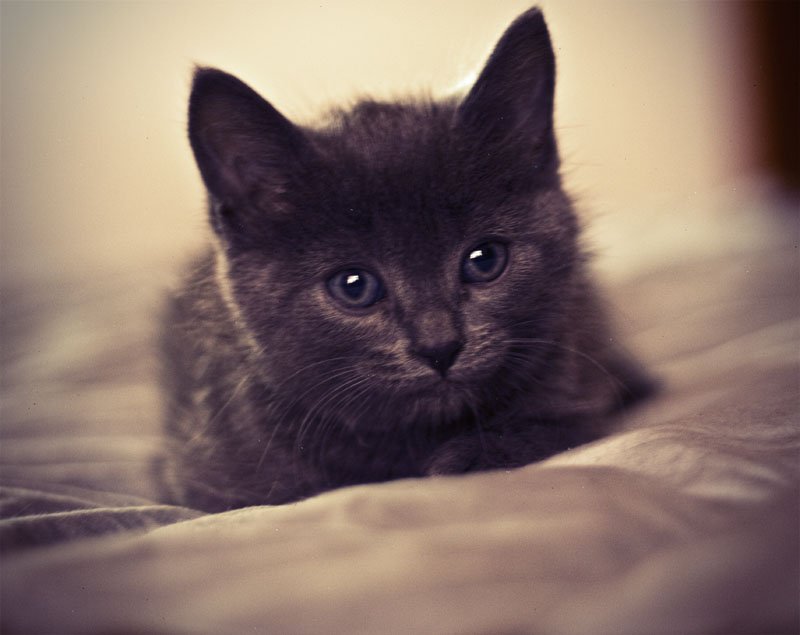 This is the baby that came home with me today, about 10 minutes after perfecting the hand sanitizer recipe.
She does not have a name yet.
I can’t have another cat that goes by 8 different names (our other cat has been Mishy, Infinity, Ace, Bacon, Dirt, Chairman, Fatty, and Dummy so far).
Any suggestions on a name that should stick?
In kittens-licking-your-fingers-don’t-count-as-sanitizers crunch!



 Life, Death and the Alzheimer’s In Between
Sandy
i work in a nursing home and i use sanatizer alot…as well as washing my hands…i cannot wait to try making this
hey
This came out very watery, and runny. Better used as a spritz sanitizer, than a hand gel type. I didn’t have any glycerin, and did not add the extra 1/8 cup of aloe vera gel to make up for it since others had commented on the watery final product too. I would make next time with less alcohol perhaps, and more aloe vera gel to make thicker maybe, or maybe adding the glycerin would do this too.
call the kitten nymph or lavender
Awwwwww! The cat is so cute you should, if its a boy name it blueberry because of its eyes and if its a girl name it sweetypie!
Just curious if using pure vitamin E from the capsules would be better than using the glycerin? BTW my son is addicted to AXE cologne and just a little works well for his as scent! Lol! Why not name the little one – Crunch?
Just made this but without the glycerin. The ratio of aloe to alcohol seemed to create a very watery product. So, I had to add more aloe vera to “thicken” it up enough so it would not poor out of the plastic bottle I bought to put it in. Since we don’t use hand sanitizer that much (prefer soap and water to really get your hands clean, not just germ-free) and one of my daughters get dry red skin if whe used sanitizer too much, I am not that concerned that the alcohol % will be lower than the storebought stuff is. Anyone else have this problem with the thickness? Stacey @ FeedingMyTribe
Also, i tried putting some rose essential oil in, but I think that it is a waste of $$, since the alcohol smell is so strong. I won’t bother using the oils next time I make it. If you use hand sanitizer, I guess you have to accept that your hands will smell like rubbing alcohol. 🙂
Name new kitty precious.
Name your kitty Pewter!
Unless I’m calculating this wrong… the recipe above doesn’t result in a santitizer with ~65% alcohol concentration, but ~61%.
Let’s take it with what’s in the recipe:
3/4 cu. Ethanol @ 91% = 12 fl. oz. 91% ethanol.
1/4 cu. aloe = 4 fl. oz. aloe
1/8 cu. glycerin = 2 fl. oz. glycerin
Total volume: 18 fl. oz.
Total volume of 100% ethanol: 91% of 12 fl. oz. = 10.92 fl. oz.
Alcohol by volume: 10.92 / 18 = 60.667% ~= 61%
If I up the ethanol concentration to 95% (190 proof), I get a better number: 63.3%
Seems to me you would actually need 12.8 oz of 91% ethanol, or what I would officiallt call a “smidge” higher than the 3/4 cu. that is listed. 🙂
If you wanted to use a lower-concentration of grain alcohol, you would need about a full cup (with all other ingredients balancing out to the 18 oz., so reduce the aloe and glycerin as well). Unfortunately, that could create some balancing problems, I’d imagine.
Sorry for the lengthy comment. 😉
You are brilliant! I can’t wait to make this. I already have all the ingredients because I sell homemade bath & beauty products, and this will be so handy to have around the house and office!
where you can buy glycerin, is it in the drugstore, or supermarket? can you use eucalyptus oil? cause, here in our place, only vanilla and eucalyptus are available… please reply asap……
I like Lavendar!
Obviously, you should name your kitty Crunchy. Or Geranium. Or Crunchy. Or Lavendar. Did I mention Crunchy?
Adding essential oils isn’t just for aromatherapy. Many of the oils you note have strong antibacterial, antiviral, antifungal properties. Tea tree oil is an all-purpuse germ killer. Lavender is as well, though some would argue not as strong. Oregano oil is being used to help kill antibiotic resistant staph. Clove oil is a superior antibacterial, as are lemon, rosemary, sage, peppermint, and grapefruit. Be careful with tea tree oil, clove, and grapefruit since they’re skin irritants in high concentrations. Grapefruit & tea tree oil are used to remove warts & skin tags, so use them with caution. But use any essential oil with caution & pregnant women or those with immune deficiencies shouldn’t use them without consulting a doctor. The kitty looks just like my chartreux who passed a few years ago. She was Dusty. Great site btw. ;p ~Jessie
i just whipped up a batch of this sanitizer…I omitted the glycerin & added the extra aloe…Is it normal for the aloe to gum up on the sides of the blender? I haven’t added my essentials yet, but can’t see where that will make a difference. Not all gummed up but it was enough for me to be concerned…does aloe get old? Also at this point, it’s not very gel-like…I did notice that the liquid is kind of warm from blending…maybe it will gel once it cools down? Thanks…
i had the same issue and did not use the glycerine. it is very watery and the food processor was spitting out the liquid like crazy. i have no idea why it did that! anyhow, it filled 1/2 of an old bath and body soap bottle. i asssume it is effective still.
I need help on where to find pure aloe vera gel. I see it at CVS for sunburns but I’m guessin that is not it. help please!
A question please.
Can I substitute the vegetable glycerin with the glycerin that I saw at the drug store? What’s the difference?
Betty, awesome recipe! I’m so glad i found it. I’m going to a very long trip this week, I will definitely whip up this hand sanitizer.
Ok, I have no idea how I missed this post earlier, so glad I read it. I’m all mushy from the kitty cuteness. I can’t stand it but I keep looking. Parker Posey is so cute! She looks like our Tylin when she was a bitty baby. I hope Parker isn’t as cranky. 🙂
Ok, I started because I was intrigued with the hand sanitizer (I’m have an allergic reaction on my hands right now – and damnit, I don’t know to what.)
And then I saw the kitty!
I was going to suggest “Whisp,” because of her smoky gray color…but Parker Posey is adorable so I’m totally okay with that.
Heya,
Firstly, condolences on your grandfather passing away.
Secondly, I don’t really use hand sanitizers. I actually associate them with Americians because the first I saw it being used was by one. However, hopefully I found a job soon and can afford tickets to festivals. In which case I’ll will be all over these recipes like… a me with money in a dress store? I can’t think of a decent simile.
Thirdly, I was thinking we should do an experiment. Remember that cellulite recipe I wrote in a comment? I was thinking we should both try it and compate results (assuming you have cellulite.) Or we could use a recipe you come up with. Anyway, I’d just like to do a comparison of something because sometimes I wonder if the results are in my head. Its chill if you’d rather not, of course.
Fourthly, I hope you are having a nice day.
Thanks for the recipes. I actually prefer to just wash my hands with soap; I think it is a simple and time-tested method of getting your hands clean. But, obviously, to each her own.
What I wanted to add was a word of caution on cinnamon essential oil. Using 10 drops of just that in hand sanitizer could be… unwise. Some people are quite sensitive to it. The skin on hands is pretty tough compared to the face and scalp, but people (especially children) tend to touch their faces and might break out into hives as a result of such a reaction. Just be careful.
I, too, prefer the soap and water method. My mother has a tendency to use hand sanitizer all the time – even after washing with soap and water. It’s odd, to say the least. But I do like to have it handy if there’s no soap or water around (and I find myself in an untoward rest stop bathroom that doesn’t have any soap and only a trickle of cold water … heh.)
You’re right about the cinnamon. I, personally, haven’t had any issues with it, but I use it very sparingly. Still, with any essential oil, it’s important to watch your concentrated exposure.
Thanks for the comment!
Well…it should clearly be Scout.;)
Aww. That’s adorable!
Actually, I called her Parker Posey yesterday for reasons I don’t even understand, and it stuck. So … drum roll … she’s Parker Posey!
It’s a really good thing you put the picture of the kitty at the end! I read the whole post and the awesome instructions for DIY hand-sanitizer BEFORE my brain melted from cute-overload and massive envy! What a sweet little doll-face she is! I go for walks and maybe come home with a feather or some acorns. Maybe a rock. Geez.
I am notorious for being bad at naming pets (and changing my mind after I’ve named them), but here goes (stream-of-consciousness): Crunchy (of course), Cruncher, Betty (duh), Betsy, Bettina, Gum Drop, Dolly, Diesel, Smitty, Susie-Q, Coco (or Coco Puff), Lulu, Lola, Carlotta, Dizzy, Mimi, Fuzzy, Mo, Jo Jo, Schnitzel, I told you I was bad at this. If you don’t want her, can I have her?
And now they want her own kitty. Awesome.
Clarabel says Flower, after flower from Bambi and her stuffed zebra.
Laila says Budget. Rythms with fudget?
My choice is Twinkle.
Well, obviously you need to name the incredibly adorable kitty Queen Frostine. You know, since you were making sanitizer.